
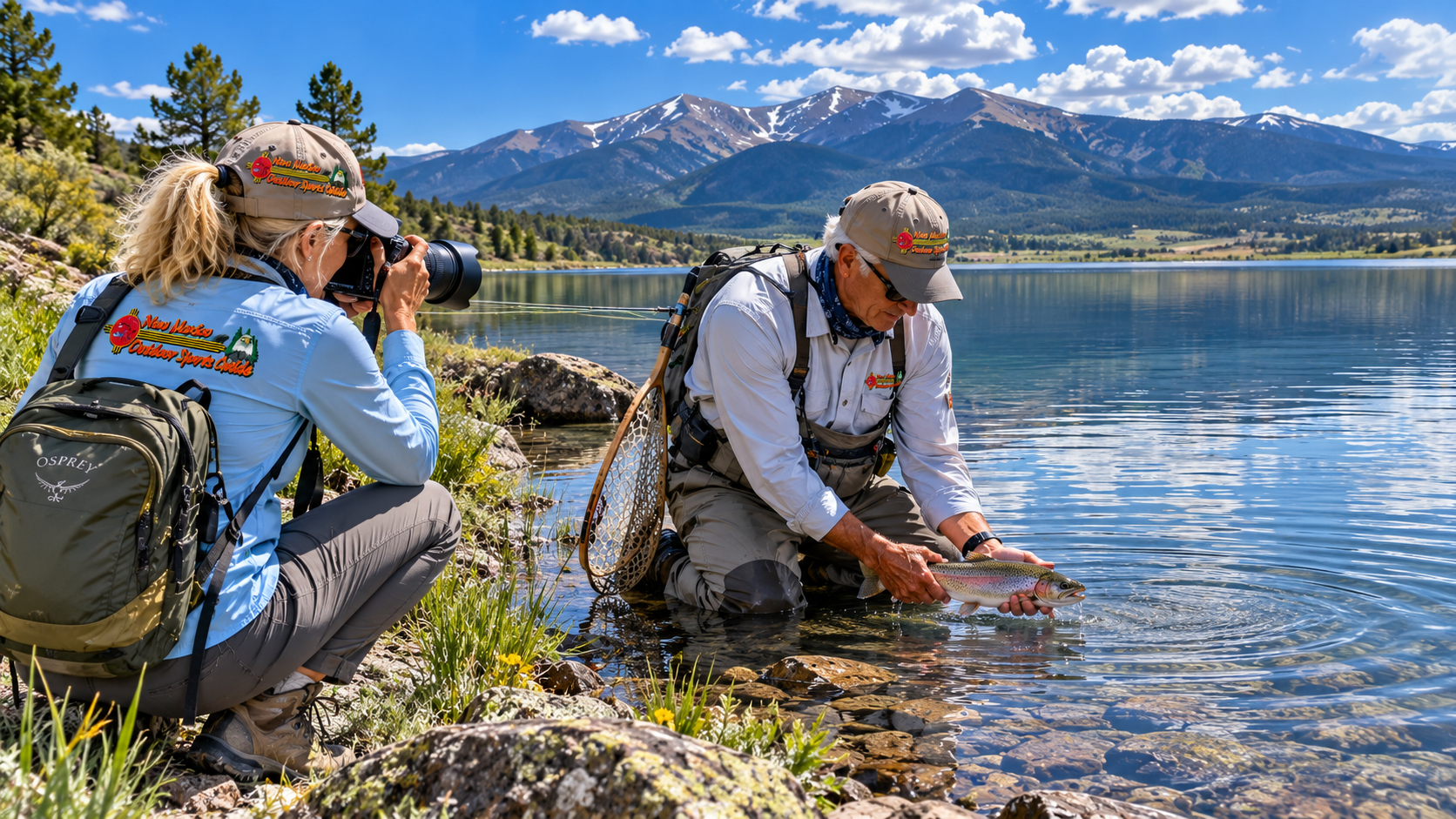
Eagle Nest Lake State Park: The Lake That Was Always Calling Us Home
There are places you visit, and then there are places that quietly become part of the furniture of your life.
For Paulette and me, Eagle Nest Lake State Park belongs firmly in the second category.
During the seventeen years we lived at Casa Oso, the log home we built high in the Angel Fire Ski Resort, Eagle Nest Lake wasn't simply someplace we occasionally drove to for fishing or a picnic. It was part of our everyday landscape.
From our front deck, there it was.
From the living-room picture windows, there it was.
From the bedroom windows, there it was again, lying out on the Moreno Valley floor beneath that enormous northern New Mexico sky.
Some mornings it reflected the blue so perfectly that the lake seemed to have borrowed a piece of the heavens. Other mornings it disappeared beneath fog or low clouds. Winter transformed it into a white sheet surrounded by snow-covered mountains. Summer thunderstorms marched across the valley and turned its surface charcoal gray.
And every so often Paulette and I would look down from Casa Oso and, without much discussion, decide:
We ought to go down to the lake.
So we did.
Sometimes I carried fishing gear. Sometimes we put the canoe on the vehicle. Occasionally we rented a boat. More often we carried cameras, hiking shoes and something for lunch.
The lake didn't always require an agenda.
Sometimes Eagle Nest Lake was enough.
And I think that is still the best way to understand Eagle Nest Lake State Park.
It isn't merely a fishing destination or campground.
It's a place to spend a day.
Where Is Eagle Nest Lake State Park?
Eagle Nest Lake State Park sits in the Moreno Valley of northern New Mexico along the Enchanted Circle Scenic Byway, immediately south of the little village of Eagle Nest.
The state park lists its elevation at roughly 8,200 feet, which explains a great deal about the climate. A July morning here can make you forget entirely about the furnace-like temperatures baking much of the Southwest. (New Mexico EMNRD)
The official address is:
Eagle Nest Lake State Park
42 Marina Way
Eagle Nest, New Mexico 87718
575-377-1594
Eagle Nest Lake State Park official information
The surrounding Moreno Valley is one of my favorite landscapes in New Mexico.
The Sangre de Cristo Mountains rise on either side. Wheeler Peak, New Mexico's highest summit, dominates the western skyline. Angel Fire lies south of the lake, Eagle Nest sits at its northern end, and US 64 climbs east into Cimarron Canyon.
It's all tied together by the Enchanted Circle.
During our Casa Oso years, this wasn't vacation country.
It was home.
What Was It Like Looking at Eagle Nest Lake From Casa Oso?
Living above the Moreno Valley gave us something visitors don't ordinarily get.
Time.
We watched the lake through seasons rather than weekends.
I could sit on our deck with morning coffee and see what the weather was doing around Eagle Nest before I'd checked a forecast.
There were days when sunlight hit the water while our mountainside remained beneath clouds.
There were thunderstorms when I could watch curtains of rain cross the valley.
Sometimes sunlight broke underneath those storms and painted the mountains in colors that no camera ever quite reproduced.
And then there were the elk.
We watched herds move across the Moreno Valley, sometimes hundreds of animals together. In the evening light they could appear almost ghostlike as they crossed the grasslands.
I've mentioned those years overlooking Eagle Nest in my article about drivable New Mexico alpine lakes, because living above the lake gave me an appreciation for alpine water that went far beyond fishing.
It was part of the rhythm of home.
Eagle Nest Lake was always calling.
How Did Eagle Nest Lake Become Part of the Moreno Valley?
Eagle Nest Lake is a reservoir, despite fitting into the Moreno Valley so naturally that it sometimes looks as though it has always been there.
The lake collects mountain water in this high valley before it flows east into the Cimarron River below the dam.
That connection makes for a wonderful combination.
You can fish the open water of Eagle Nest Lake and then, within a relatively short drive, find yourself beside a narrow trout stream in Cimarron Canyon.
In fact, anglers wanting to add some moving-water fishing to their trip can explore my guide to public access on the Cimarron River.
The contrast is remarkable.
One minute you're standing beside a broad mountain lake beneath an enormous sky.
The next you're threading a fly through pocket water beneath canyon walls.
That's northern New Mexico for you.
What Can You Do at Eagle Nest Lake State Park?
Fishing gets much of the attention, but Eagle Nest Lake State Park offers hiking, birding, wildlife watching, picnicking, camping, photography, boating, canoeing, kayaking and winter recreation.
The state lists 7.78 miles of trails, along with opportunities for hiking and birding. The park also accommodates motorized boats and nonmotorized craft including canoes, kayaks and paddleboards. (New Mexico EMNRD)
That variety was exactly why Paulette and I returned so often.
Some days I wanted to fish.
Some days she wanted to photograph wildlife.
Some days we both just wanted to walk.
And sometimes the grand plan was nothing more ambitious than lunch beside the water.
Those often turned out to be some of our best days.
Hiking Around Eagle Nest Lake
Walking around the lake was probably our most frequent activity.
At 8,200 feet, even a relatively easy walk deserves some respect if you're arriving from lower elevations. The air is thinner, the sun stronger and the weather considerably more changeable than many visitors expect.
But what country for a walk.
The lake keeps appearing from different angles as you move along the shoreline. Across the water rise the mountains surrounding Moreno Valley, and clouds constantly rearrange the light.
That's one reason I seldom hiked without a camera.
A landscape photographer could spend an entire summer here and never take exactly the same picture twice.
Paulette and I have always enjoyed the act of walking almost as much as arriving anywhere.
Maybe that's the ranch upbringing still hanging around in me.
You notice more on foot.
Tracks.
Wildflowers.
Birds.
A change in the wind.
An elk far across the valley that you'd never notice through a windshield.
The older I've become, the more convinced I am that the outdoors reveals itself according to the speed at which you travel through it.
Walking is about right.
Why Is Eagle Nest Lake So Good for Photography?
Eagle Nest Lake offers the photographer something wonderfully valuable:
Layers.
You have water in the foreground.
Grasslands and sage across the valley.
Forested mountain slopes beyond.
Then the higher Sangre de Cristo peaks.
Finally, that huge New Mexico sky.
Morning is particularly beautiful.
The air often begins calmer, giving the lake a chance to reflect the mountains and clouds. Later, mountain winds can roughen the surface.
Late afternoon brings its own rewards as the sun angles across the valley.
Then there is wildlife.
Osprey, waterfowl and other birds can provide opportunities around the lake. Elk are an important part of the broader Moreno Valley landscape, and black bears inhabit the surrounding Sangre de Cristo country.
New Mexico wildlife officials document black bears throughout these mountains. Their research has included a northern Sangre de Cristo study area bordered by Moreno Valley and encompassing country near Eagle Nest, Ute Park and Cimarron Canyon. (NMDOW)
New Mexico black bears, incidentally, aren't necessarily black. The Department of Wildlife notes that they occur in black, brown, cinnamon, reddish and even blond color phases. (NMDOW)
We always treated wildlife photography the same way we treated wildlife itself.
Give it room.
A long lens is much better than crowding an animal.
What Fish Live in Eagle Nest Lake?
Now we come to a subject close to my heart.
Fishing.
New Mexico Department of Wildlife information identifies Eagle Nest as a cold-water fishery supporting rainbow trout, kokanee salmon, northern pike, yellow perch and white suckers. The state park also describes the lake as regularly stocked with trout and salmon. (NMDOW)
Rainbow trout remain especially important to the fishery. NMDOW fisheries-management information says surveys found that 67 percent of Eagle Nest anglers considered rainbow trout the lake's most important fish. (NMDOW)
And those rainbows continue receiving help.
On May 7, 2026, for example, NMDOW reported stocking 11,088 triploid rainbow trout averaging 8.9 inches into Eagle Nest Lake. (NMDOW)
The kokanee aren't merely incidental residents, either.
The current New Mexico record kokanee salmon came from Eagle Nest Lake: a 5-pound, 22-inch fish caught in 2021. (NMDOW)
That's quite a salmon for a mountain lake in New Mexico.
Check Your New Mexico Fishing License Before You Cast
Before discussing tackle, here's something more important.
Check that your fishing license is current before you leave home.
New Mexico's 2026-2027 fishing rules are the authority for current requirements, limits and special regulations. Licenses are available online, by telephone at 888-248-6866, from NMDOW offices and authorized license vendors. (NMDOW)
New Mexico Department of Wildlife fishing information and licenses
Don't depend on what you remember from last year.
Regulations change.
And Eagle Nest has several rules worth knowing.
The posted portion near the dam is closed to fishing. A special kokanee snagging season runs October 1 through December 31. Current regulations also specify that northern pike caught at Eagle Nest must be kept and may not intentionally be returned to the lake. There is no bag or possession limit for northern pike there. (NMDOW)
That last regulation is particularly important when we discuss catch-and-release.
Where Is the Public Fishing Access?
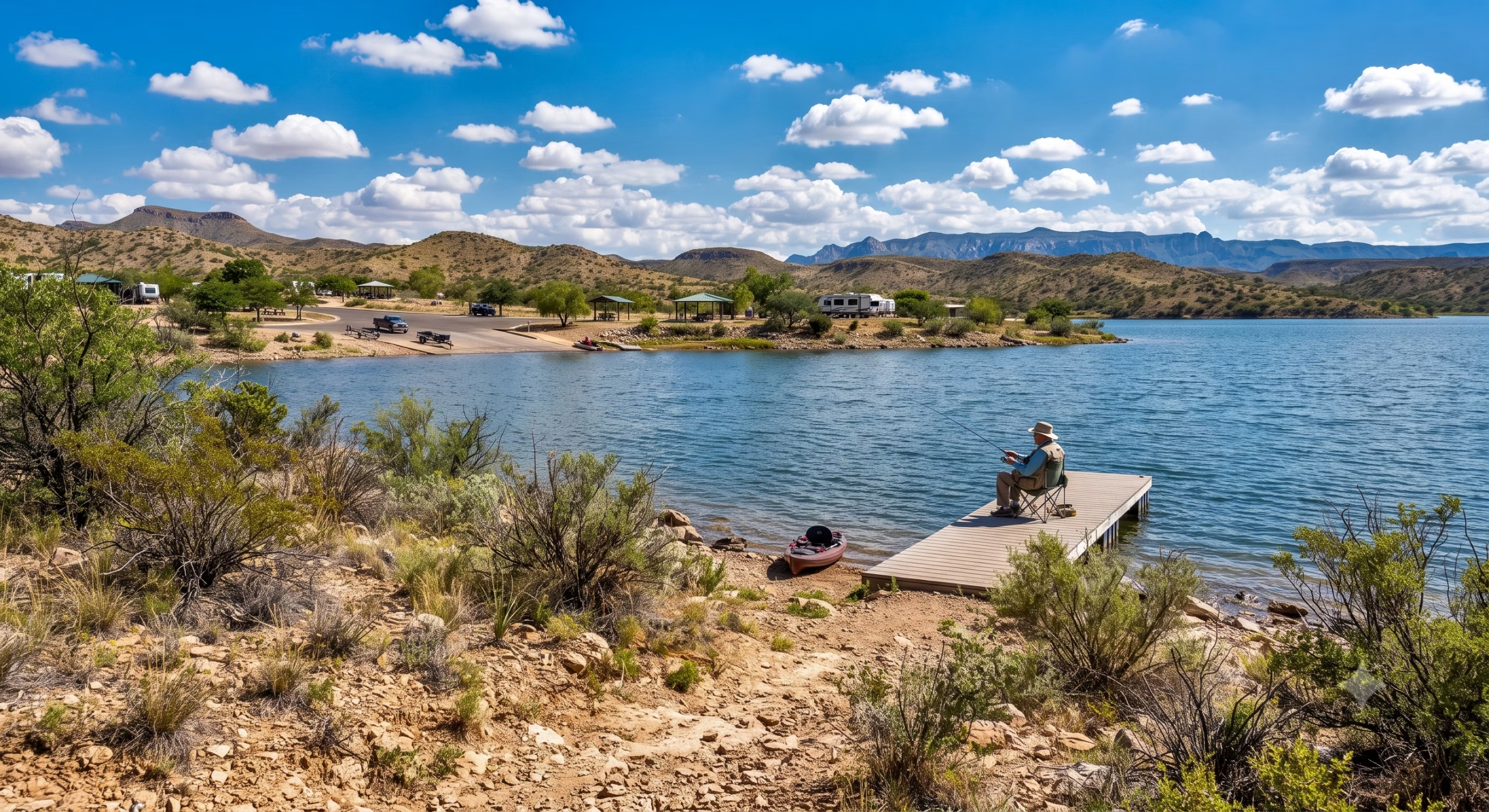
One thing I appreciate about Eagle Nest Lake State Park is that you don't necessarily need a boat.
The state specifically permits fishing from the bank as well as by boat. (New Mexico EMNRD)
Shore anglers can work accessible sections of the state park shoreline, while boaters can cover considerably more water.
But remember that not every inch of shoreline surrounding a western reservoir should automatically be treated as public access.
Use designated state-park areas and established access points, respect posted closures and never cross private property merely because you can see water on the other side.
A fishing rod isn't a trespass permit.
How Do I Fish Eagle Nest Lake With Spinning Tackle?
For trout, I like keeping spinning equipment uncomplicated.
A 6- to 7-foot light or medium-light spinning rod paired with a quality 1000- to 2500-size spinning reel handles most trout fishing nicely.
For line, 4- to 8-pound monofilament or fluorocarbon is practical, with 6-pound line a good middle ground. Another option is light braid with a fluorocarbon leader.
Clear mountain water rewards subtlety.
From shore, I'd carry a small selection of:
- inline spinners in roughly 1/16- to 1/4-ounce sizes,
- small spoons,
- compact minnow-style plugs,
- soft-plastic grubs and small swimbaits,
- appropriate natural or prepared baits where current regulations permit their use.
Silver, gold, copper, trout-pattern and darker natural colors all deserve room in the tackle box.
On bright days, I often favor more natural presentations.
Under clouds or in lower light, a little flash can help.
Retrieve speed matters as much as lure color.
Cold trout generally don't need something screaming past them like it owes money.
Slow down.
Experiment with depth.
Let the fish tell you.
What Fly-Fishing Equipment Works at Eagle Nest Lake?
Paulette and I enjoyed fly fishing here, and stillwater fly fishing requires a slightly different mindset than working a mountain stream.
A 9-foot 5- or 6-weight fly rod is a wonderfully versatile choice.
Match it with a reliable fly reel and enough backing for the occasional fish that decides to make a serious run.
I'd carry a weight-forward floating line for shallow work and surface activity, along with either an intermediate sinking line or sinking-tip option for getting flies deeper when trout move away from shore.
Leaders in the 9- to 12-foot range work well in clear conditions, adjusted for wind and fly size.
My fly box would include:
Nymphs: Pheasant Tail, Hare's Ear, Prince Nymph, Copper John, chironomid/midge patterns and small balanced leeches.
Streamers: Woolly Buggers, leech patterns and small baitfish imitations.
Dry flies: Adams, Griffith's Gnat, Elk Hair Caddis and other patterns matching whatever is actually hatching.
Stillwater trout often cruise.
Watch before casting.
A rise here.
Another twenty yards away.
Then another.
Sometimes the fish will draw you a map if you're patient enough to read it.
What Water Temperatures Are Most Productive for Trout?
Trout are cold-water fish.
As a practical fishing guideline, water roughly in the 50s to low 60s Fahrenheit is often a comfortable and productive range for active rainbow trout.
As temperatures rise toward the upper 60s, trout experience increasing physiological stress, particularly when combined with low dissolved oxygen.
At Eagle Nest's elevation, water generally stays cooler than many lower-elevation reservoirs, but shallow summer water can still warm substantially.
That affects both fishing success and fish survival.
Carry a thermometer.
It's one of the least expensive pieces of useful fishing equipment you'll ever own.
What Is the Best Time of Day to Fish Eagle Nest Lake?
I'm an early-morning fisherman by nature.
Always have been.
At Eagle Nest, morning has several advantages.
The wind is often lighter.
Water temperatures are cooler.
Trout may move shallower.
Insects begin stirring.
Boat traffic is usually lower.
And the light across Moreno Valley is worth getting out of bed for even if the fish don't cooperate.
Interestingly, the state park also specifically recommends morning for canoeing, kayaking, rowing and paddleboarding because of the lake's cold, quiet conditions. (New Mexico EMNRD)
Late afternoon and evening can produce another feeding period.
But keep one eye on those mountains.
Summer thunderstorms can build rapidly in the Sangre de Cristos.
Lightning and an open mountain lake are a poor combination.
How Should I Practice Safe Catch-and-Release?
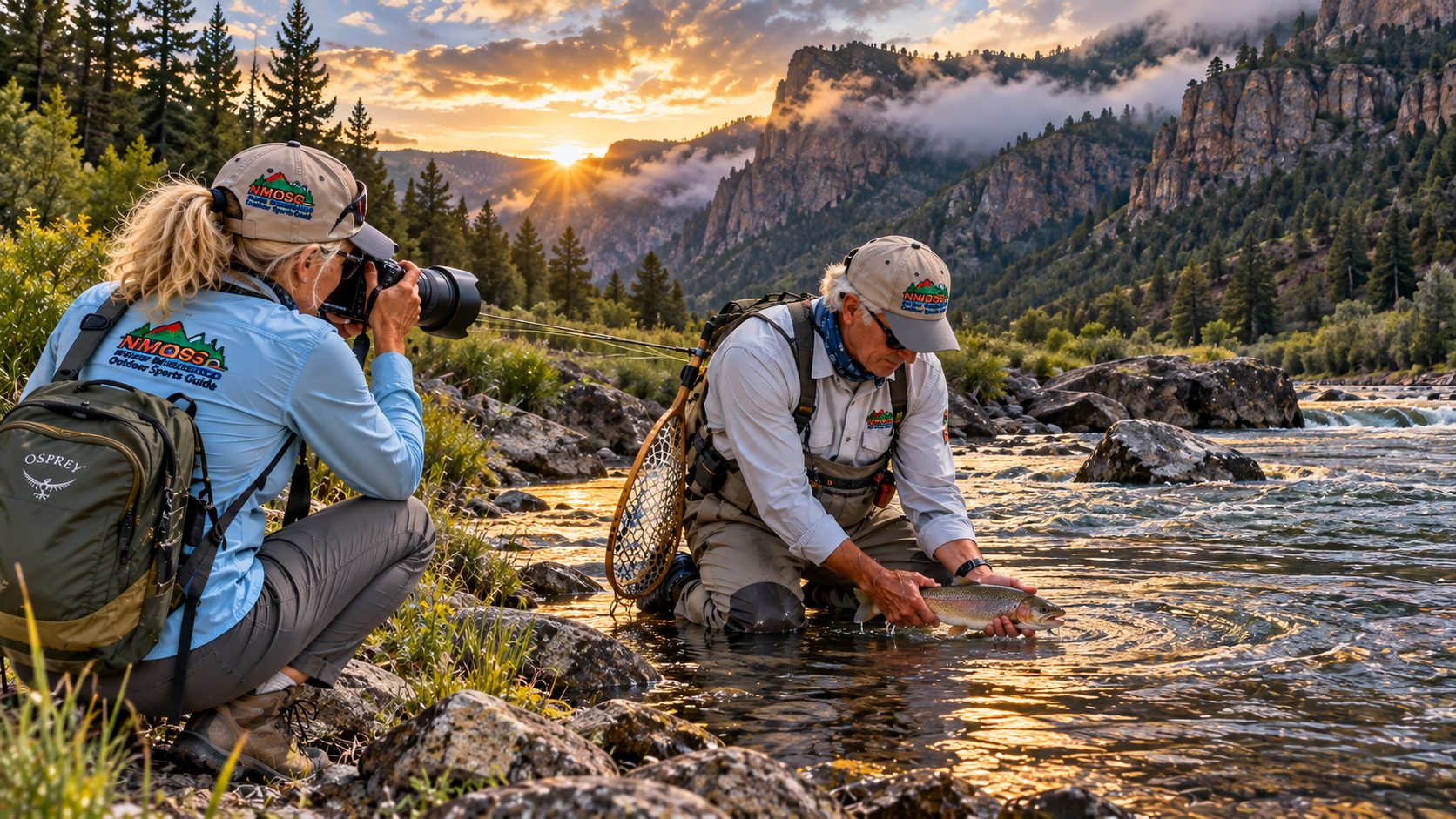
When we're releasing trout, I try to make the encounter brief.
Use tackle stout enough to land the fish without exhausting it.
Wet your hands before touching the trout.
Keep it in the water whenever practical.
Use a rubber or fish-friendly landing net.
Remove the hook quickly.
Barbless hooks or pinched barbs make that easier.
Don't squeeze the fish.
Don't put fingers in its gills.
And don't spend two minutes arranging a photography session while a trout suffocates in your hands.
A quick photograph is plenty.
Then support the fish gently in the water until it swims away under its own power.
But remember the special Eagle Nest rule:
Northern pike are not catch-and-release fish at Eagle Nest Lake.
Current regulations require anglers to retain them. (NMDOW)
Responsible fishing means following the biological management rules for the water you're fishing, not simply applying one philosophy to every species.
Canoeing Eagle Nest Lake
Our canoe gave Paulette and me a wonderfully quiet way to explore the lake.
No roaring motor.
No hurry.
Just paddle strokes and water against the hull.
From a canoe you notice things that disappear at speed.
Birds working the shoreline.
Changing water color.
Trout dimpling the surface.
Cloud reflections.
Wind beginning to build.
Eagle Nest's water is cold, however, and cold mountain water deserves respect.
The park currently requires approved PFDs to be worn while on the water. (New Mexico EMNRD)
Wear them.
Not stored under a seat.
Not tied to the canoe.
Wear them.
And watch the wind.
A pleasant morning paddle can become considerably more energetic when afternoon wind begins pushing down the valley.
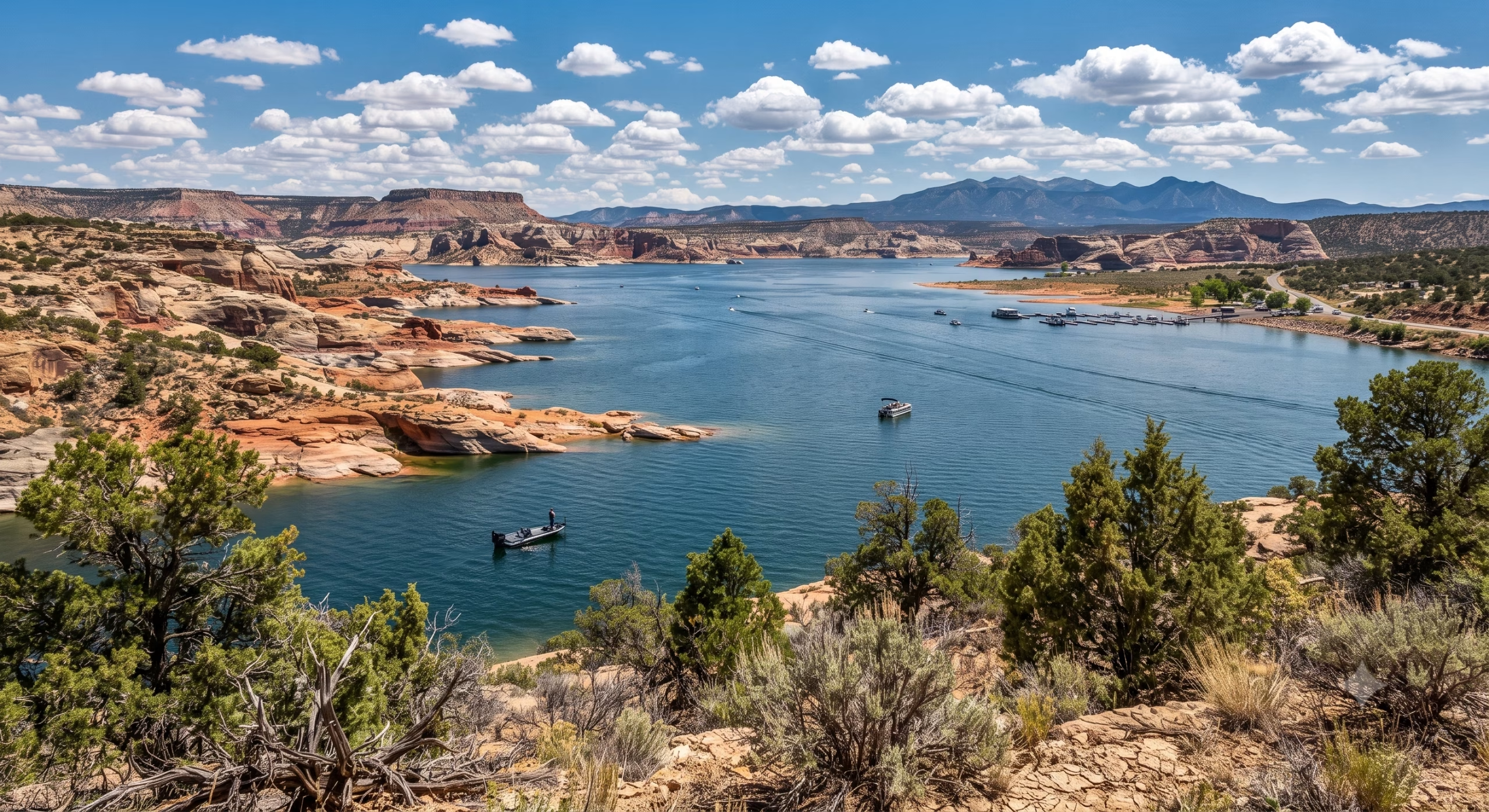
What About Boat Fishing and Rentals?
We occasionally rented a boat during our Casa Oso years, and a boat opens up an entirely different fishery.
You can search points, drop-offs, deeper basins and roaming schools rather than waiting for fish to approach the bank.
Boat rentals and concession services can change from year to year, however, so I recommend checking locally rather than assuming the rental operation you remember from a previous trip is still operating.
NMDOW's current license-vendor list includes Eagle Nest Cabins & Marina in the village, which makes the community a logical place to check current services. (NMDOW)
And current lake conditions matter tremendously.
As of September 2026, conditions are unusually low. State Parks reports Eagle Nest at approximately 1,026 surface acres, with the ramp restricted to one lane and courtesy docks removed because of low and declining water. Boaters are warned about unknown hazards and advised to keep motors trimmed up. (NMED)
Those conditions can change, so check immediately before towing a boat there.
Current Eagle Nest Lake State Park alerts
Picnicking Beside Eagle Nest Lake
Not everything needs to become an expedition.
Some of our nicest days were simply picnics.
Find a legal picnic area.
Bring sandwiches.
Pour coffee.
Watch the clouds.
Let somebody else worry about being productive.
There's an unfortunate modern habit of turning recreation into accomplishment.
Miles hiked.
Fish caught.
Photographs taken.
Summits reached.
Sometimes Paulette and I were perfectly content to sit beside Eagle Nest Lake and accomplish absolutely nothing.
I recommend it highly.
Camping at Eagle Nest Lake State Park
The park has developed camping rather than primitive camping.
State Parks currently lists 19 reservable sites during May through September, centrally located water, vault toilets and no dump station. Camping during the primary season is reservation-based, with first-come options available during portions of the off-season. (New Mexico EMNRD)
The campground received substantial improvements completed in 2026, including electrical service at campsites, expanded tent pads, renewed shelters, new fire rings and tables, accessibility improvements and upgraded facilities. (New Mexico EMNRD)
Always check current fire restrictions before assuming you can build a campfire.
As I write this in September 2026, Eagle Nest Lake State Park remains under Stage II fire restrictions, prohibiting campfires, charcoal and similar open-flame uses while allowing certain controllable liquid-petroleum or LPG devices under specified conditions. (NMED)
Conditions change.
Yesterday's rules don't put out today's wildfire.
Where Can I Stay in Eagle Nest, New Mexico?
If camping isn't your preference, the Village of Eagle Nest offers cabins, vacation rentals, small lodges and other accommodations, with considerably more lodging available in nearby Angel Fire, Red River and Taos.
During our Casa Oso years, of course, our lodging was easy.
We drove back up the mountain to our own log home.
Visitors can use Eagle Nest as a quiet base or combine the lake with the larger Enchanted Circle.
Angel Fire lies about 12 miles away, Red River roughly 19 miles, and Taos about 30 miles from the park. (New Mexico EMNRD)
For a longer trip around the mountains, my article about a summer vacation in Red River, New Mexico offers another natural addition to an Eagle Nest visit.
What Are the Seasons Like at Eagle Nest Lake State Park?
Spring
Spring arrives reluctantly at 8,200 feet.
Snow can linger, nights remain cold and wind can make a pleasant temperature feel considerably less pleasant.
But warming water awakens the fishery.
Bring layers.
Summer
Summer was our favorite season.
Days are generally comfortable compared with lower New Mexico elevations, mornings can be downright cool, and afternoon thunderstorms are part of mountain life.
The lake, trails and campgrounds are busiest then.
June also brings another familiar Moreno Valley spectacle. My story about Balloons Over Angel Fire captures some of that high-country summer atmosphere.
Fall
Fall may be the prettiest season of all.
Aspens turn gold.
Morning temperatures drop.
Elk activity increases.
Crowds diminish.
The light becomes softer.
A September afternoon beside Eagle Nest can make a fellow seriously reconsider every other place he's ever called beautiful.
Winter
Then winter takes possession.
Eagle Nest Lake can freeze sufficiently for ice fishing, and State Parks notes that ice fishing is generally available January through March when conditions permit. Cross-country skiing and snowshoeing are also among the park's winter activities. (New Mexico EMNRD)
Never assume lake ice is safe because somebody walked across it last week.
Check current park conditions.
How Do I Get to Eagle Nest Lake State Park?
From Santa Fe
Figure roughly 95 to 105 miles, depending on route, and about two hours under normal conditions.
A common route runs north toward Española and Taos, then east on US 64 through the mountains toward Eagle Nest.
The scenery improves nearly every mile.
From Albuquerque
Depending upon route, plan on approximately 150 to 165 miles and roughly three hours.
A common approach follows I-25 north toward Santa Fe, then continues north through Española and Taos before taking US 64 east toward Eagle Nest.
Allow more time in winter.
Mountain roads write their own schedules.
From Taos
This one is simple and beautiful.
The park is approximately 30 miles east of Taos via US 64, and State Parks gives an approximate driving time of 50 minutes. (New Mexico EMNRD)
You'll climb through mountain country before dropping toward Moreno Valley.
Don't rush it.
You're already on vacation.
Eagle Nest Lake and the Larger Enchanted Circle
One of Eagle Nest's strengths is that you don't have to choose between lake, stream, mountain town and forest.
They're all here.
Spend the morning fishing Eagle Nest.
Drive into Cimarron Canyon after lunch.
Explore Angel Fire.
Continue around toward Red River.
Photograph Wheeler Peak.
Then return to the lake for evening light.
If you're interested specifically in fly fishing the nearby Cimarron, my older guide to Rio Cimarron trout fly-fishing public access provides another useful starting point.
That's five different NMOSG stories linked naturally into this article, each opening another door into the country surrounding Eagle Nest.
Why Eagle Nest Lake State Park Still Feels Like Home
Paulette and I don't live at Casa Oso anymore.
We left Angel Fire in 2017 and made Santa Fe our summer home, trading some of those long, snowy mountain winters for a somewhat gentler climate.
But landscapes become attached to memory.
I can still picture the view through those big windows.
Wheeler Peak.
Moreno Valley.
Bobcat Pass.
And Eagle Nest Lake.
Always Eagle Nest Lake.
There were mornings when I'd glance through the glass and know from the color of the water what kind of day we were likely to have.
There were evenings when the last sunlight caught the lake while the mountains around us had already slipped into shadow.
There were elk crossing the valley.
Storms.
Snow.
Fog.
Summer wildflowers.
Golden autumn aspens.
And ordinary Tuesdays that didn't seem important at the time but somehow became precious years later.
That's the funny thing about memory.
The great adventures remain.
But so do the quiet days.
Paulette and I walking beside Eagle Nest Lake.
A fishing rod in my hand.
A camera over her shoulder.
The canoe sliding through calm morning water.
Lunch beside the shore.
Driving back toward Angel Fire at the end of the afternoon.
Nothing historic happened.
No record fish.
No heroic mountain climb.
No once-in-a-lifetime event.
Just another day together in the Moreno Valley.
I've lived long enough now to understand that those may have been the once-in-a-lifetime events after all.
Final Thoughts on Eagle Nest Lake State Park
If you're planning a trip to northern New Mexico, give Eagle Nest Lake State Park more than a quick stop beside the highway.
Bring a fishing rod.
Bring binoculars.
Bring a camera.
Pack a picnic.
Walk the trails.
Rent a boat if current services and lake conditions allow it.
Launch a canoe on a calm morning.
Camp beneath the mountain sky.
Watch for elk across Moreno Valley.
Keep bear country clean and never leave food where wildlife can reach it.
Check your fishing license.
Check current fishing regulations.
Check fire restrictions.
Check lake and boat-ramp conditions.
And then, after you've checked everything that modern life insists we check, put the telephone away for a while.
Sit beside the water.
Listen.
Look across Eagle Nest Lake toward the mountains.
Let the wind move through the grass.
Watch a cloud shadow travel across the Moreno Valley.
You might begin to understand why, during all those summers Paulette and I lived at Casa Oso, we kept finding reasons to drive down there.
Truth be told, we didn't always need a reason.
We could see Eagle Nest Lake from our front deck, living room and bedroom.
It was always out there.
Always changing.
And always calling.
0 Comments