
Capturing Fall Colors in Angel Fire: A Rainy September Journey Back Home
There are some things a man keeps because he needs them.
There are other things he keeps because parting with them feels suspiciously like admitting that a chapter of life has ended.
My chainsaw apparently belonged in the second category.
It had been nine years since I'd used the perfectly good thing.
When Paulette and I left Casa Oso, the log home we built in the forest above Angel Fire, and moved to our home on two acres near Santa Fe in 2017, my relationship with trees changed considerably. At Casa Oso, we were surrounded by forest. Trees were part of daily life, and occasionally they needed to become firewood.
At Casa Santa Fe, we have only a scattering of piñon and juniper.
These days, the occasional trimming job around the property could be handled by one of those little electric chainsaws that weighs about as much as the lunch I used to carry into the woods.
Still, there sat the old chainsaw.
Perfectly good.
Unused.
Waiting.
Our son Shannon lives about fifteen miles west of Taos in an adobe home he built himself, and he heats it with a wood stove. I finally asked him whether he could use my chainsaw.
"Sure."
That settled it.
The chainsaw had found its next assignment.
And I had found an excuse to go looking for autumn.
Why Was I Chasing Fall Colors in Angel Fire?
I had been chomping at the bit to get into the mountains with my cameras.
Late September had arrived, and northern New Mexico was beginning that wonderful transition when summer reluctantly loosens its grip and autumn starts painting the landscape from the highest elevations downward.
That's the important thing about Capturing Fall Colors in Angel Fire. You don't simply circle a date on the calendar and expect the mountains to obey.
Fall color moves.
It starts high.
Then it works its way down the mountainsides.
One grove can be brilliant gold while another, perhaps only a few miles away, remains green.
That's exactly what Angel Fire's current fall information describes. The first aspen color generally begins appearing in mid-September, with stronger color developing into late September and early October. Lower-elevation cottonwoods typically follow later. Angel Fire Resort
New Mexico's tourism office offers similar advice. High country around Taos, Red River and the Sangre de Cristo Mountains commonly begins changing during September, with color gradually moving downslope as autumn progresses. New Mexico
In other words, you don't really schedule fall photography in northern New Mexico.
You hunt it.
And that was exactly what I intended to do.
So day before yesterday I loaded the chainsaw into the Subaru Outback, followed it with enough camera gear to make the chainsaw seem lightweight, and headed north toward Taos.
I had an errand to run.
But I also had autumn to chase.
How Do I Photograph a Road Trip Without Missing the Road Trip?
I've discovered something over the years.
Some of the best scenery happens when there isn't a safe place to stop.
You round a curve and suddenly there it is: sunlight breaking beneath a cloud, an elk standing in a meadow, rabbitbrush glowing beside the highway, or a mountainside illuminated for perhaps thirty seconds before the light changes.
By the time you find a turnout, the photograph is gone.
That's one reason I keep a small action camera, either a DJI Osmo Nano or Insta360 GO Ultra, mounted near the rearview mirror in the Outback.
Turn it on.
Drive.
Let the camera collect the country coming over the hood while I concentrate on driving.
For this trip I particularly wanted that camera running when I reached US 64 between Taos and Angel Fire.
The rabbitbrush had been blooming.
And when rabbitbrush decides it's autumn in northern New Mexico, subtlety isn't part of the plan.
It turns the roadside yellow.
Not pale yellow.
Not politely yellow.
Yellow.
The kind that seems to manufacture its own sunlight.
A Short Stop in the Rio Grande Gorge
Before reaching Taos, though, the Rio Grande interrupted my plans.
It has a habit of doing that.
Passing through the Gorge, I spotted a group of rafters being prepared by their guide near the Quartzite River Access.
The guide appeared to be giving that familiar pre-trip briefing while everybody listened with the particular attentiveness people develop when they're about to trust a rubber raft to a river.
What really caught my attention was the Rio Grande itself.
The water was extraordinarily low, lower than I could remember seeing it.
I couldn't simply drive past.
So I pulled into the parking area, got out and walked over for a closer look and a few images.
It wasn't intended to become a major stop.
There was a chainsaw waiting for a new owner in Taos, coffee somewhere in my immediate future, and golden aspens somewhere beyond that.
Still, the Gorge deserves a few minutes whenever it asks for them.
I've photographed and traveled this country for decades, yet the Rio Grande Gorge continues to surprise me. Earlier this year I wrote about driving through the Rio Grande Gorge near Taos, and more recently Paulette and I returned to capture a completely different perspective in my story about the Rio Grande Gorge at Taos from a drone's-eye view.
This morning was different again.
Low water.
Rafters.
September light.
Another face of an old friend.
After a very short stop, I climbed back into the Outback and continued toward Taos.
Does the View Into Taos Ever Become Ordinary?
No.
Apparently not.
I topped the Gorge rim with the mirror-mounted camera recording, and that enormous view opened ahead of me.
The Taos Valley.
The Sangre de Cristo Mountains.
The high desert stretching outward beneath that tremendous New Mexico sky.
I've been seeing versions of that view for more than half a century.
It is still breathtaking.
That's one of the gifts of northern New Mexico that I've never quite been able to explain.
Familiarity doesn't diminish it.
It deepens it.
You recognize the ridges.
You know which road disappears into which canyon.
You remember snowstorms, summer thunderstorms, autumn afternoons and winter mornings.
A stranger sees a beautiful landscape.
After fifty years, you see a beautiful landscape filled with your own history.
The little camera behind my windshield captured the view.
I simply enjoyed it.
Coffee With Shannon in Taos
Shannon was waiting for me at The Coffee Apothecary, his favorite coffee shop in Taos.
It's a local roaster on Paseo del Pueblo Sur, and we settled at one of the outdoor tables along the street. Coffee Apothecary
The chainsaw changed hands.
Mission accomplished.
That probably should have been the end of the story.
But the chainsaw was really only the opening act.
We sat outside with our coffee and visited for a while.
There is something especially pleasant about sitting with your grown son over a cup of coffee when neither one of you has anywhere you absolutely must be for the next few minutes.
Eventually it was time to go.
My plan was to leave Taos on US 64, climb through Taos Canyon, cross the mountains into Angel Fire and check the aspens. From there I intended to continue south through Black Lake and Mora, on toward Las Vegas, and eventually turn the Outback toward Casa Santa Fe.
It would make a wonderful autumn loop.
At least that was the plan.
New Mexico weather had some editing to do.
Why Is US 64 Between Taos and Angel Fire One of My Favorite Roads?
It was still early when I left Taos on Highway 64.
I've been driving that road for more than fifty years.
I still love it.
US 64 through Taos Canyon is part of the Enchanted Circle Scenic Byway, the mountain loop around Wheeler Peak connecting communities including Taos, Angel Fire, Eagle Nest and Red River. Angel Fire describes the full scenic loop as about 84 miles. Angel Fire
"Enchanted Circle."
Somebody got the name right.
As I left Taos, the rabbitbrush was spectacular.
Great banks of yellow flowers lined the road, and the mirror camera was catching them as the highway rolled beneath the Outback.
Then the light joined the show.
The sun began peeking through distant cumulus buildups behind the rabbitbrush, creating exactly the kind of changing illumination a photographer hopes to stumble across.
Bright flowers in the foreground.
Darkening clouds beyond.
Sunlight breaking through openings.
Road disappearing into the mountains.
And the camera was already running.
Perfect.
Even the cottonwoods along the Rio Fernando de Taos were beginning to show touches of autumn. The Rio Fernando is indeed one of the small streams associated with the Taos landscape, with a USGS monitoring site east of town. USGS Water Data
September hadn't finished painting yet.
But she'd opened the paint box.
Capturing Fall Colors in Angel Fire Begins Before You Reach Angel Fire
That's something photographers sometimes forget.
If your destination is Angel Fire, don't wait until you reach the village before looking for autumn.
The journey from Taos is part of the photograph.
Rabbitbrush owns the lower country.
Cottonwoods begin changing along water.
Then elevation increases.
Ponderosa pine, fir and spruce darken the mountainsides.
And eventually the aspens begin flashing yellow among the evergreens.
Those dark conifers are what make the aspens really sing in a photograph.
Yellow against yellow is pretty.
Yellow against deep green is drama.
Angel Fire Resort describes autumn as beginning around mid-September, with the aspens typically providing the major high-country show before the lower-elevation cottonwoods reach their strongest color later. Angel Fire Resort
The window is short.
Weather can move it around.
Elevation can shift it by days or weeks.
That's why I like scouting.
Sometimes being a little early is more interesting than arriving at peak.
You get green, lime, yellow and gold on the same mountainside.
That's exactly what I found this time.
But first I had to get there.
The Monsoon Hadn't Finished With the Mountains
The closer I got to the pass, the more obvious it became that monsoon season wasn't quite ready to leave the stage.
Clouds were building.
I had seen this movie before.
For seventeen years at Casa Oso, Paulette and I had a front-row seat to mountain weather.
You learn to read it.
You watch where the clouds are forming.
You notice whether the bases are darkening.
You watch the direction the rain shafts are moving.
You don't become a meteorologist.
You simply develop a healthy respect for what those mountains can manufacture in an afternoon.
As I dropped into the Moreno Valley, I could see a rain cell toward the southern end.
I figured I had perhaps an hour before it reached the area I wanted to explore.
Plenty of time.
Famous last words in mountain country.
Returning to One of Our Favorite Places Above Angel Fire
I wasn't heading toward a random grove of aspens.
I was returning to a place loaded with memories.
High above the Moreno Valley was a hunting camp Paulette and I visited regularly during our years at Casa Oso.
Beyond it stretched a meadow perhaps three miles long, with grass reaching roughly to the knees in places and aspens lining its edges.
It was wildlife country.
Real wildlife country.
We spent many sunsets there waiting for elk herds to emerge from the aspens.
And emerge they did.
Sometimes we found ourselves astonishingly close.
There were evenings when bulls were calling from the timber, and I can still remember the first time I heard one make that peculiar high-pitched sound.
I laughed out loud.
Here stood an animal built like royalty, hundreds of pounds of muscle carrying an enormous rack of antlers, ruler of the autumn forest...
...squeaking.
Nature has a sense of humor.
Anyone expecting every elk vocalization to sound like thunder is in for a surprise.
We saw wild turkeys there.
Black bears.
Elk.
Sometimes combinations of all three.
Whenever visitors from the flatlands came to stay with us at Casa Oso and wanted to see wildlife, this was one of the places we took them.
It was never an absolute guarantee.
Wild animals don't honor reservations.
But it was about as close to reliable as wildlife watching gets.
I hadn't been back there for a while.
Now I was climbing toward it again.
Alone this time.
Camera gear beside me.
Rain moving across the valley.
And seventeen years of memories riding along.
For readers who want a broader picture of the country Paulette and I called home, my story about Eagle Nest Lake State Park in the Moreno Valley describes another piece of that landscape that became part of our everyday lives.
Hiking Toward the Aspen in the Rain
At the trailhead I parked the Outback and started loading my pack.
Cameras.
Rain gear.
Batteries.
The usual collection of gadgets that somehow multiplies every time somebody invents another camera.
A few raindrops were already falling.
One of the greatest developments for an outdoor photographer and videographer has been the small camera.
Action cameras have become remarkably capable. You can carry excellent video capability in a package small enough to disappear into a pocket.
For this trip I also carried my Insta360 Luna Ultra, with its one-inch main sensor and telephoto capability, protected from the weather inside the pack. Insta360 specifies the Luna Ultra with a 1-inch main sensor, a separate 1/1.3-inch telephoto sensor and zoom capability that has recently been extended through firmware. Insta360
One important correction for anyone carrying the same camera into mountain weather: despite its outdoor-friendly size, Insta360 says the Luna Ultra itself is not waterproof or splashproof. Mine therefore stayed protected whenever rain threatened it. Insta360 Online Manual
I shouldered the pack.
The rain began.
And up the trail I went as if I had good sense.
Were the Angel Fire Aspens at Peak Color Yet?
No.
And that was all right.
The aspens were just beginning to turn.
Patches of yellow had appeared among leaves that remained green. Individual trees seemed farther along than their neighbors. The transformation was underway but hadn't reached the great golden crescendo that would come later.
That matches the normal progression around Angel Fire. Mid to late September commonly brings those first waves of color, while stronger displays tend to develop afterward, depending on elevation and weather. Angel Fire Resort
I shot video.
I photographed leaves.
I photographed the meadow.
I photographed the transition itself.
Peak color gets all the attention, but there's something beautiful about catching autumn while it's still making up its mind.
Green summer hasn't quite left.
Gold autumn hasn't quite arrived.
For a few days they share the same tree.
Where Were the Elk?
The rain became steadier as I approached the old hunting camp.
Not a downpour.
Just rain.
Good elk weather, I thought.
I began scouting the edge of the meadow.
Nothing.
I kept looking.
Still nothing.
About an hour passed.
No elk.
That's wildlife photography.
You can own the best camera in the world, know the country, understand the animals, choose the right weather, arrive at the right time...
...and photograph absolutely no elk whatsoever.
The elk hadn't read my itinerary.
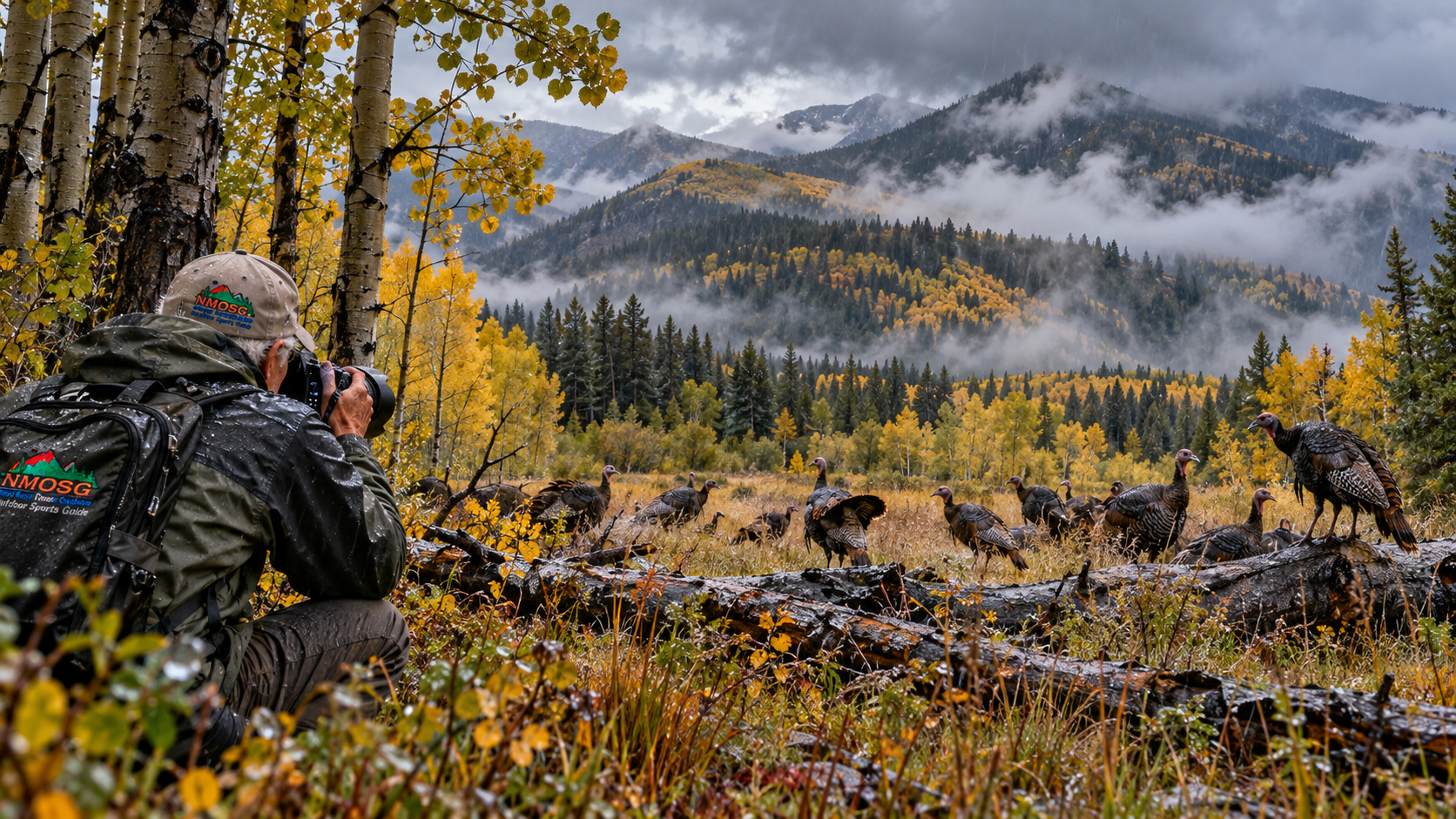
I did spot a flock of perhaps eight wild turkeys in the distance.
That would turn out to be a preview.
After shooting some photographs and video of the early aspen color, I finally started back toward the Outback.
And that's when the day changed.
What Is "Absolute Calm"?
The rain had softened.
It wasn't really falling hard anymore.
It had settled into a light, steady, windless rain.
Zero wind.
I have my own name for those moments.
The Absolute Calm.
I've experienced it in light snow too.
No wind.
No branches moving.
No roar through the treetops.
No mechanical noise.
Just precipitation falling vertically through still air.
Walking beneath the aspens, I could hear individual raindrops striking leaves.
Tick.
Tap.
Tick.
Everything else seemed to have stopped.
There is a calm in those moments that I have trouble describing.
Not silence exactly.
Something better.
The world is still making sounds, but none of them are demanding anything from you.
No urgency.
No destination.
No clock.
Just rain on aspen leaves.
I've experienced that feeling many times in the mountains, but I never tire of it.
Then the Wild Turkeys Appeared
There they were.
On the trail ahead of me.
Another flock, this one perhaps a dozen birds.
I stopped.
Normally, wild turkeys don't need much encouragement to leave.
They see you.
They stretch their necks.
Some internal alarm goes off.
And suddenly you're looking at turkey backsides disappearing through the timber.
These didn't.
They kept feeding.
I was roughly fifty yards behind them.
So I started shooting video.
They browsed slowly along the trail, communicating among themselves with quiet clucks and a soft, almost catlike purring sound.
And I followed.
Slowly.
Very slowly.
What Years Around Wildlife at Casa Oso Taught Me
Living at Casa Oso gave Paulette and me an education no classroom could have provided.
Behind our house in the forest was an old fire road.
To us it was a fire road.
To the animals it was a highway.
Elk used it.
Mule deer used it.
Black bears used it.
Wild turkeys used it.
We had a sunroom at the back of the house overlooking that corridor, and over seventeen years we spent thousands of hours watching wildlife pass.
You begin noticing patterns.
One of the strongest was the effect of wind.
Animals are extraordinarily sensitive to movement, scent and sound. Wind changes all three.
On windy days, wildlife often appeared tense and watchful.
Heads up.
Ears moving.
Stopping.
Looking.
Listening.
The forest was full of uncertain noises and shifting scent.
On very calm days, the same animals often seemed transformed.
They sauntered.
They fed.
They lingered.
That old fire road could look less like a wildlife corridor and more like a Sunday promenade.
I believe something similar was happening with these turkeys.
The forest was utterly calm.
I wasn't moving quickly.
I wasn't making sudden sounds.
I wasn't approaching directly.
So they apparently decided I wasn't particularly interesting.
That's about the highest compliment a wildlife photographer can receive.
Ten Yards From a Wild Turkey Flock
I followed them at their pace.
Not mine.
That's important.
Eventually the birds reached a small opening among the aspens where a dead tree had fallen.
Several hopped onto the aspen laydown.
And then they started preening.
That told me a great deal.
They weren't merely tolerating me while preparing to flee.
They were comfortable enough to attend to feathers.
The rain began easing.
I moved closer.
One careful step.
Stop.
Another.
Stop.
Watch the birds.
Another step.
Eventually I was within perhaps ten yards of the clearing.
I very slowly opened the protected pocket containing the Luna Ultra.
The birds stayed.
I began filming.
With the telephoto reach, I could frame them as though I were practically sitting among the flock without having to crowd them physically.
Feathers filled the frame.
Heads moved in and out.
Birds preened.
Others stood on the fallen aspen.
Quiet little vocalizations passed among them.
Rainwater clung to feathers and leaves.
I filmed for perhaps fifteen minutes.
It felt like more than an hour.
Time stopped.
There are outdoor experiences you plan.
Then there are outdoor experiences that find you.
This one found me.
Wildlife Photography Is Sometimes About Doing Less
That encounter reinforced something I've believed for years.
Wildlife photography isn't always about getting closer.
Often it's about becoming less important.
Move slowly.
Stay quiet.
Don't block an escape route.
Don't chase.
Don't surround.
Don't force an animal to choose between you and where it wants to go.
And use the reach of the camera rather than your feet whenever possible.
The finest wildlife encounters I've experienced weren't the ones where I imposed myself on an animal.
They were the ones where, for a few minutes, the animal simply continued living while I watched.
That's what happened with those turkeys.
For a little while, I ceased to matter.
It almost felt as though I had become part of the flock.
I knew better, of course.
But don't spoil it for me.
Why Fall Photography Around Angel Fire Is So Special
There are more famous fall-color destinations in America.
But northern New Mexico has its own palette.
Aspen gold against ponderosa green.
Rabbitbrush yellow against sage.
Cottonwoods following rivers through tawny grass.
Dark volcanic country around the Rio Grande.
The enormous cobalt New Mexico sky.
Then add weather.
Cloud shadows sweep across mountainsides.
Rain turns aspen trunks silver.
A shaft of sunlight suddenly ignites one grove while everything around it remains dark.
Photography becomes less about recording color and more about recording light moving across color.
Angel Fire's fall season generally stretches from mid-September into October, but the strongest color varies from year to year and by elevation. Visit Angel Fire New Mexico -
That's why I'd rather have cameras ready and go exploring than obsess over predicting the perfect date.
Autumn isn't a studio model.
She doesn't take appointments.
The Enchanted Circle Still Enchants Me
The more I thought about it during this trip, the more appropriate that name seemed.
Enchanted Circle.
I have driven these roads for more than fifty years.
Paulette and I lived in these mountains for seventeen.
We watched storms cross Wheeler Peak.
We watched elk move through the Moreno Valley.
We watched Eagle Nest Lake change moods from one hour to another.
We watched snow bury our mountain.
We watched aspens turn yellow and then surrender their leaves to the wind.
You'd think familiarity would eventually wear away the enchantment.
It hasn't.
My earlier story about Balloons Over Angel Fire and the Moreno Valley captures the country in another season entirely, but the landscape is the same old friend.
Maybe that's what enchantment really is.
Not being amazed by something once.
Being amazed by it for fifty years.
Why I Finally Had to Leave the Turkeys
I didn't want to.
But late afternoon was creeping in.
I had a long drive back to Casa Santa Fe.
And one thing I've become increasingly reluctant to do is drive mountain roads after dark when I don't have to.
Elk.
Deer.
Other wildlife.
Curving mountain highways.
Darkness.
That's a combination I prefer to avoid.
So eventually I lowered the camera.
The turkeys continued with their afternoon.
I started down the trail.
No dramatic goodbye.
No cinematic ending.
Just a man walking away through wet aspens while a flock of wild turkeys went back to being wild turkeys.
Perfect.
Then My Phone Found Cell Service
Back at the Outback, technology rejoined the story.
I had cell coverage again.
And waiting for me were flash-flood alerts.
The storm cells I had been watching weren't finished.
Not remotely.
I packed the cameras, changed out of what needed changing, got into the Outback and started toward Mora.
Another cell moved through.
The rain intensified.
By the time I reached canyon country approaching Guadalupita, water was running across portions of the road.
I slowed way down.
Very cautiously, I worked my way through the weather and eventually continued toward Mora and Las Vegas.
A word of caution belongs here.
Flash flooding is nothing to gamble with. Conditions can change quickly, and water across a roadway can conceal damage, depth and current that aren't apparent from the driver's seat. If the depth or road condition is uncertain, turning around and waiting is the right decision. No photograph and no schedule are worth losing a vehicle, or a life.
Mountain weather had given me one of the most peaceful wildlife encounters I've experienced in a long time.
Now that same weather was reminding me who was actually in charge.
The Rain Followed Me Home
It rained much of the rest of the way.
The landscape gradually changed as I left the higher mountains behind.
Aspen country faded.
Ponderosa gave way.
The road carried me toward Las Vegas and eventually back toward Santa Fe.
The cameras were packed.
The chainsaw was gone.
Memory cards were full.
And somewhere behind me, those turkeys were probably still wandering through the wet forest without giving me another thought.
I reached Casa Santa Fe safely before dark.
That mattered.
And there was Paulette.
My beloved partner in so many of these mountain adventures.
Sadly, she couldn't make this particular trip with me.
I missed having her there.
Especially during that encounter with the turkeys.
She would have loved it.
But perhaps that's one reason we carry cameras.
I couldn't bring Paulette along that day.
I could bring a little of the day home to her.
What Did I Bring Home From Angel Fire?
I left Santa Fe intending to accomplish two things.
Give Shannon a chainsaw.
Photograph some fall color.
Mission accomplished on both counts.
But those weren't what made the day special.
The unexpected things did.
Rafters preparing beside an unusually low Rio Grande.
That familiar view opening as I topped the Gorge.
Coffee with my son at a sidewalk table in Taos.
Rabbitbrush blazing yellow along US 64.
Sunlight peeking beneath building cumulus clouds.
The first hints of color appearing in cottonwoods.
Aspens just beginning their autumn transformation.
Rain falling without wind.
The sound of droplets touching aspen leaves.
A trail.
A dozen wild turkeys.
A fallen tree.
Birds preening.
Fifteen minutes that somehow escaped from the clock.
And finally the long wet road home to Paulette.
Funny how often the best days work that way.
You go looking for one thing.
The mountains give you something else.
Capturing Fall Colors in Angel Fire Is Really About Capturing Time
I thought this trip was going to be about fall foliage.
In one sense, it was.
I got the rabbitbrush.
I got the aspens.
I got the changing cottonwoods.
I got clouds, rain and mountain light.
But when I sat down afterward and thought about the day, I realized the color wasn't really the story.
Time was.
Nine years had passed since I'd needed that chainsaw.
Nine years since we left Casa Oso.
More than fifty years had passed since I first began driving some of those northern New Mexico roads.
Shannon is no longer a boy. He's a grown man who built his own adobe home and now has a use for one of his father's old tools.
I'm no longer the young fellow who first discovered these mountains.
And yet there I was again.
Driving US 64.
Watching the light.
Looking for elk.
Walking through aspens.
Following wild turkeys.
Carrying cameras.
Coming home to Paulette.
So much has changed.
And so much hasn't.
Perhaps that's why photography has meant so much to me over the years.
A photograph can't stop time.
Video can't either.
But every once in a while, they can persuade time to leave something behind.
A yellow rabbitbrush blossom.
Rain on an aspen leaf.
A turkey preening on a fallen tree.
A shaft of sunlight breaking through a September cloud.
For anyone interested in another side of autumn in this country, my story about late fall hiking in Taos, New Mexico follows that golden season after it has progressed farther into the mountains.
This trip caught it nearer the beginning.
One More Autumn in the Mountains
When Paulette and I lived at Casa Oso, fall was something that happened around us.
We didn't have to drive somewhere to find it.
We watched it arrive.
A few aspens would change.
Then a grove.
Then a mountainside.
The Moreno Valley would turn tawny.
Elk would become increasingly active.
Nights would sharpen.
The first hard freeze would come.
Eventually the aspens would be bare.
Then one morning we'd look outside and discover that winter had quietly moved onto the mountain.
Living there for seventeen years gave us the luxury of seeing the entire transition.
Now I have to go looking for it.
I don't mind.
In fact, maybe the chase makes me pay closer attention.
This year I was a little early for peak aspen color.
Good.
That gives me an excuse to go back.
Although next time I hope Paulette can ride along.
There are still photographs to make.
There are still roads to drive.
There are still elk somewhere in those aspens refusing to appear on schedule.
And there will always be another patch of yellow around the next bend.
After more than fifty years, that road between Taos and Angel Fire still enchants me.
After nine years away from Casa Oso, those mountains still feel familiar.
And after all these decades carrying cameras into the outdoors, a dozen wet wild turkeys can still make fifteen minutes disappear.
I started the day with an old chainsaw in the back of an Outback.
I ended it with rain on the windshield, full memory cards and another story I couldn't possibly have planned.
Turned out to be a very special day.
Then again, northern New Mexico has been doing that to me for much of my life.
0 Comments