
By Pat | New Mexico Outdoor Sports Guide
There's an old Gene Autry song that has been rattling around in my head for more years than I care to count.
Back in the Saddle Again.
When I was a youngster growing up on cattle ranches in the Kansas Flint Hills, Gene Autry was one of my favorite singing cowboys. Every time we saddled our horses to move cattle from one pasture to another, I'd find myself singing that tune.
Sometimes I sang it to myself.
Sometimes I sang it to my horse.
Whether the horse appreciated my singing is another matter entirely.
Now, more than seven decades later, I've discovered that a fellow doesn't necessarily need a horse to get back in the saddle.
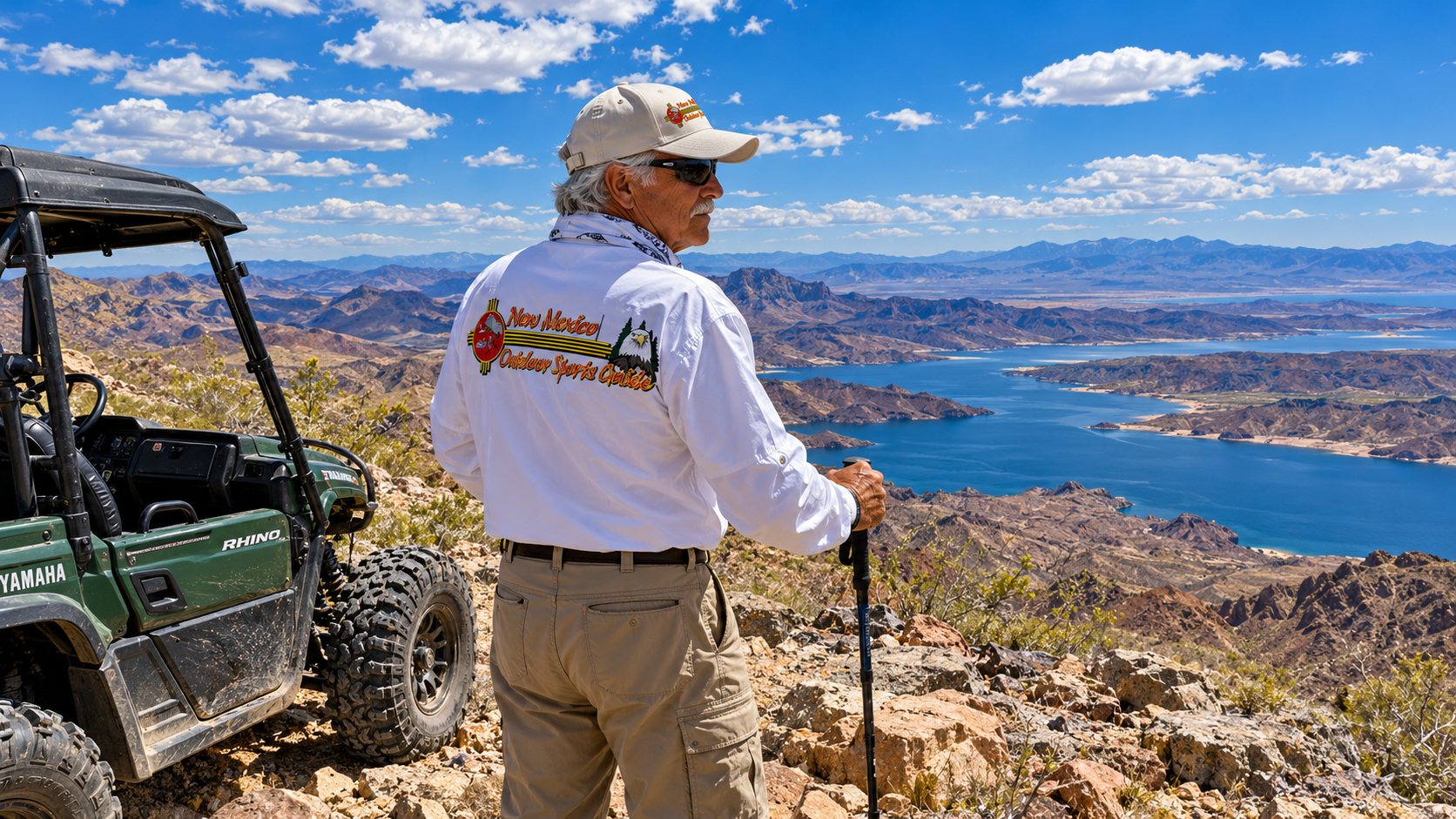
A Yamaha Rhino OHV will do just fine.
So here I go again.
I'm back in the saddle again, my Yamaha Rhino saddle, that is.
Out where a friend is a friend.
Ridin' the range, desert trails, that is.
Totin' my old .44, 9mm, that is.
Somewhere up there, I suspect Gene Autry is shaking his head.
But I'm smiling.
Because after another splendid summer in Santa Fe, Paulette and I are back at Casa Codorniz, our winter home in the Black Mountains overlooking Lake Mohave and the Colorado River.
And I have a little unfinished business with an old abandoned mine.
Not because I expect to find gold.
Not because I'm looking for silver.
I've reached an age where the treasure I'm most interested in finding is another beautiful sunrise, an old trail I haven't explored lately, and a quiet place to sit with my camera and watch the desert come alive.
This morning's destination is Old Wagon Trail Mine, about a mile southwest of our place.
The Rhino is ready.
The desert is calling.
And this old cowboy is back in the saddle.
Back Home at Casa Codorniz Above Lake Mohave
There's something special about returning to a place you've grown to love.
For seventeen wonderful years, Paulette and I enjoyed our log home, Casa Oso, high in the mountains at Angel Fire, New Mexico.
From our mountain home we watched the seasons move across Moreno Valley, with Wheeler Peak, Bobcat Pass, and Eagle Nest Lake providing a landscape that never seemed to grow old.
We loved the snow.
We loved the elk.
We loved the forests.
We loved the mountain streams.
But eventually, winter began lasting a little longer than we wanted it to.
After moving to Santa Fe in 2017, we settled into a comfortable arrangement that suits us beautifully.
Summers in northern New Mexico.
Winters in the Arizona desert.
Our winter home, Casa Codorniz, also known as High Chaparral, sits on the eastern slopes of the Black Mountains above Lake Mohave.
From our place, the lake lies roughly five miles west and some 1,700 feet below us.
Beyond the blue water rises the rugged country surrounding Spirit Mountain, known to the Mojave people as Avi Kwa Ame, a sacred landscape with deep cultural significance.
Farther north, the Colorado River winds through its magnificent desert corridor below Hoover Dam.
On a particularly clear day, looking west and northwest across the lake, I can see distant mountain ranges layered against the horizon.
From the higher country around Old Wagon Trail Mine, Mount Charleston, west of Las Vegas, can sometimes be picked out on the far horizon, roughly ninety miles away.
That's a lot of country to take in from one little mountain.
And I never tire of looking at it.
First Things First: Getting the House and Rhino Ready
Returning to a seasonal home isn't quite the same as checking into a hotel.
There are chores.
Always chores.
After unloading the Subaru and unpacking our belongings, I had to get the well back online and make sure everything around the house was operating properly.
Water is something a fellow learns to appreciate in the desert.
At our elevation, surrounded by creosote, mesquite, cactus, and rocky slopes, a functioning well is more important than almost anything else.
Once the household systems were behaving themselves, my attention turned to the Rhino.
Now we're getting somewhere.
The Yamaha Rhino has become my modern version of a dependable ranch horse.
It doesn't need hay.
It doesn't need brushing.
And it generally doesn't object when I sing.
It does, however, appreciate a charged battery, good tires, fresh fuel, and a little mechanical attention.
Before heading out, I checked the oil, coolant, tires, brakes, steering, and fuel.
I also made sure my camera gear, drinking water, first-aid supplies, and emergency equipment were aboard.
Then I climbed into the driver's seat.
Turned the key.
And listened to the engine come to life.
That familiar sound was enough to put a grin on my face.
Back in the saddle again.
A One-Mile Ride to Old Wagon Trail Mine
One of the pleasures of living at Casa Codorniz is that adventure doesn't require a long drive.
Old Wagon Trail Mine is only about a mile southwest of our place.
I can leave home in the Rhino, follow the established desert tracks, and soon find myself surrounded by the quiet, rugged landscape of the Black Mountains.
No interstate.
No traffic lights.
No shopping centers.
Just desert.
The trail winds through country covered with creosote bushes, scattered cacti, desert grasses, and rocky outcroppings.
Small washes cut across the slopes.
Loose gravel collects in the turns.
Here and there, larger rocks protrude from the trail surface.
This isn't a place for hurry.
And I don't have any reason to hurry.
At my age, I've discovered that traveling slowly allows me to see things I would otherwise miss.
A covey of Gambel's quail scurrying beneath a creosote bush.
A desert cottontail disappearing into the brush.
A raven riding the morning thermals.
The tracks of a coyote crossing a sandy wash.
Or the delicate colors of a desert wildflower that somehow found enough moisture to bloom.
Sometimes I stop the Rhino just to listen.
The desert isn't silent.
It simply speaks more quietly than most places.
What Is Old Wagon Trail Mine?
Old Wagon Trail Mine, as I've come to know this local site, is an intriguing collection of old mine workings and natural caves scattered across two small mountains in the Black Mountains above Lake Mohave.
The hills rise a few hundred feet above the surrounding terrain.
From a distance, they don't look particularly remarkable.
Just another pair of rugged desert hills.
But walk around them and you'll discover evidence that somebody once considered this country worth digging into.
There are roughly half a dozen old mine tunnels and several natural caves.
Most of the short mine openings penetrate less than thirty feet into the rock.
Three larger workings extend more than one hundred feet into the mountains.
Those deeper entrances are now gated for safety.
I know something about their approximate length because I explored them with a flashlight years ago, before the protective gates were installed.
Back then, I was curious about where those tunnels went.
Today, I'm more interested in where the trail above them leads.
And I am pleased the deeper workings have been secured.
Old abandoned mines can be deadly, even when their entrances appear harmless.
There is no photograph, mineral specimen, or historical curiosity worth a life.
I haven't established a verified historical mining claim name, operating company, or production record for these particular workings. The name Old Wagon Trail Mine is the local name I use for the site. Without supporting mining records, I wouldn't assign it a specific date or claim that gold, silver, or copper was produced there.
But the workings themselves tell a story.
Someone came into this remote desert country.
Someone hauled equipment and supplies over rough terrain.
Someone swung a pick, drilled rock, and followed a promising mineral vein into the mountain.
Whether the venture made anybody wealthy is another question.
Most small desert mining prospects never did.
Yet the determination behind them remains impressive.
And that is part of what makes exploring old mining country so fascinating.
Hiking to the Top of Old Wagon Trail Mine
The best part of this little adventure begins when I park the Rhino and continue on foot.
The summit isn't especially high compared with the mountains around Angel Fire.
In New Mexico, Paulette and I were accustomed to exploring country above 9,000 feet.
Here in the Arizona desert, a hill only a few hundred feet high can offer a surprisingly spectacular view.
The climb is rocky.
Loose stones demand attention.
The ground is uneven.
And a careless step can send a boot sliding downhill.
I take my time.
There was a day when I might have scrambled up a hillside without giving it much thought.
These days I prefer to arrive at the top with all my original parts still attached.
A hiking stick helps.
So do good boots.
And I always carry water, even on a short hike.
As I climb, the surrounding landscape gradually opens.
First, I can see the trail winding through the desert below.
Then the mountains begin revealing their ridges and valleys.
Finally, near the summit, Lake Mohave comes into view.
What a sight.
That remarkable blue ribbon of Colorado River water contrasts beautifully with the tan, brown, and reddish slopes of the surrounding desert mountains.
Looking north, the Colorado River valley stretches for miles.
Looking west, the mountains beyond Lake Mohave rise toward the Nevada horizon.
On exceptionally clear days, the distant Spring Mountains and Mount Charleston become part of the panorama.
I can stand there for a long time.
Sometimes I photograph the landscape.
Sometimes I shoot video.
And sometimes I simply sit on a rock and enjoy the view.
After eight decades of living, working, traveling, and exploring, I've learned that not every beautiful moment needs to be recorded.
Some are worth keeping just for yourself.
Lake Mead National Recreation Area: A Desert Wonderland
One reason I love this part of Arizona is its proximity to Lake Mead National Recreation Area.
Established in 1964, the recreation area protects an enormous landscape surrounding Lake Mead and Lake Mohave along the Colorado River.
It encompasses approximately 1.5 million acres of mountains, desert, canyons, shoreline, and water.
It's a remarkable place.
Most visitors naturally gravitate toward the lakes.
And I certainly understand that.
Lake Mohave has provided Paulette and me with some of our most enjoyable winter fishing.
But the country surrounding the water is every bit as fascinating.
There are old mining districts.
Historic wagon routes.
Abandoned prospects.
Desert washes.
Remote canyons.
Wildlife habitat.
Hiking trails.
And panoramic overlooks where a photographer could happily spend an entire morning.
The recreation area is managed by the National Park Service, which means visitors must respect park boundaries, road restrictions, and protected cultural resources.
An important distinction for OHV riders: Lake Mead National Recreation Area is not an unrestricted off-road riding area. Motorized travel is limited to roads and routes where vehicles are specifically permitted, and some routes may exclude unlicensed OHVs.
I always recommend checking the National Park Service backcountry regulations before riding near park boundaries.
The same caution applies to Old Wagon Trail Mine. My personal access from Casa Codorniz does not establish that the site or the connecting trails are open to public motorized travel. Visitors should verify land ownership and authorized access before attempting to reach it.
Why Are There So Many Abandoned Mines in the Black Mountains?
The Black Mountains and surrounding northwestern Arizona desert have a long mining history.
Gold, silver, copper, and other minerals attracted prospectors into this rugged country during the nineteenth and early twentieth centuries.
The country around Oatman, Katherine, and the Colorado River became particularly interesting to miners.
Mining camps appeared.
Roads and wagon trails were established.
Equipment was hauled into places that still seem difficult to reach with modern four-wheel-drive vehicles.
And countless small prospects were dug into hillsides.
Some became profitable mines.
Others produced little more than disappointment.
The Katherine mining district, near today's Katherine Landing, provides a particularly interesting example.
According to the Katherine Landing concessioner's historical account, gold was discovered in the area around 1900, and the Katherine Mine operated intermittently until about 1930.
Those old workings remind me of the determination required to make a living in this country.
Imagine arriving with a wagon, a few tools, limited supplies, and a hopeful idea about what might lie beneath the rock.
No air conditioning.
No cellular telephone.
No GPS.
No convenient parts store.
Just hard work, heat, dust, and uncertainty.
Growing up on ranches gave me an appreciation for that kind of determination.
But it also taught me that hard work doesn't always guarantee success.
There are plenty of abandoned mines scattered across the Southwest to prove it.
Exploring Old Mines by OHV: The Dangers Beneath the Mountain
This is one subject I take seriously.
I've explored enough old mine workings to understand that abandoned mines can be extremely dangerous.
The fact that I entered the longer tunnels at Old Wagon Trail Mine years ago doesn't mean I would recommend doing so today.
Quite the opposite.
Those deeper entrances have been gated for good reasons.
Old mine workings may contain unstable rock, deteriorating timbers, concealed vertical shafts, oxygen-deficient air, hazardous gases, and unexpected drops.
Some hazards are impossible to recognize from the entrance.
A tunnel that looks perfectly sound near daylight can become unstable farther inside.
And a flashlight doesn't make dangerous ground safe.
Why should you never enter an abandoned mine?
The dangers include:
-
Unstable ceilings and walls: Rock can fall without warning.
-
Hidden shafts: Vertical openings may be concealed by debris or darkness.
-
Bad air: Oxygen deficiency and hazardous gases may occur without any obvious smell.
-
Old explosives and chemicals: Historic mining materials can remain dangerous for generations.
-
Unstable flooring: Loose rock or old coverings may conceal deep openings.
-
Wildlife: Bats, snakes, and other animals may occupy abandoned workings.
-
Difficult rescue: Emergency personnel may need specialized mine-rescue equipment to reach an injured visitor.
My advice is simple.
Photograph the entrances from a safe distance.
Study the history.
Enjoy the scenery.
But stay outside.
Never climb around a gate, enter a fenced opening, disturb an old shaft covering, or attempt to squeeze through a narrow opening.
And never enter an abandoned mine alone.
In fact, without a properly equipped and authorized professional mine-exploration team, don't enter at all.
Natural caves also deserve caution. They may have unstable passages, protected wildlife, and fragile geological features.
For me, the attraction of Old Wagon Trail Mine today is the country surrounding the workings.
Not the darkness inside them.
Desert OHV Trail Riding Safety
The Yamaha Rhino is a wonderful way to explore desert country, but it requires the same respect I learned to give horses, tractors, airplanes, and boats.
Equipment doesn't forgive carelessness simply because you've operated it for years.
The Arizona Game and Fish Department OHV safety program emphasizes responsible riding, vehicle preparation, and protecting wildlife habitat.
Arizona also requires qualifying OHVs to display appropriate decals, and the state introduced mandatory OHV safety education for decal purchases beginning in 2025.
What do I carry in the Yamaha Rhino?
Even for a short ride, I prefer to have:
-
Drinking water, with extra for unexpected delays.
-
A first-aid kit and personal medications.
-
A fully charged telephone and offline maps.
-
A satellite emergency communicator for remote trips.
-
A tire repair kit, portable compressor, and basic tools.
-
Recovery equipment appropriate for the vehicle.
-
A flashlight or headlamp with spare batteries.
-
Sun protection, sturdy boots, and gloves.
-
A fire extinguisher.
-
A camera and binoculars.
-
A light jacket for changing weather.
I also wear the seat belt, use the Rhino's occupant protection equipment, and recommend a properly fitted helmet and eye protection.
I never assume a trail is safe simply because I've driven it before.
Desert storms rearrange roads.
Flash floods wash away gravel.
Rockslides occur.
A familiar route can become dangerous after one heavy thunderstorm.
And, as Arizona Game and Fish reminds riders, even a few passes outside designated routes can damage fragile habitat and create unauthorized trails.
The problem with riding alone
I enjoy solitude.
That's one of the reasons I explore the desert.
But solitude carries responsibilities.
Before heading out, I make sure Paulette knows where I'm going and when I expect to return.
On longer excursions, I prefer company.
Cell service is unreliable in many desert canyons.
A mechanical failure five miles from home can become a serious problem if the weather turns hot.
At eighty-plus years of age, I've learned that being careful doesn't diminish adventure.
It allows me to enjoy another one tomorrow.
Wildlife Around Old Wagon Trail Mine and Lake Mohave
One of my favorite things about riding slowly through the Black Mountains is the opportunity to observe wildlife.
Arizona Game and Fish identifies habitat protection as an essential part of responsible OHV recreation, particularly because motorized disturbance can interfere with feeding, nesting, and the solitude wildlife needs.
The desert may appear barren to somebody passing through at highway speed.
Spend a morning exploring on foot, and an entirely different world begins to emerge.
Gambel's Quail: The Birds That Named Our Home
Of all the creatures living around Casa Codorniz, Gambel's quail have a special place in my heart.
In fact, they're the reason I named the house Casa Codorniz.
Codorniz is Spanish for quail.
When we first discovered the property, there were so many Gambel's quail around the house that the name seemed obvious.
I love watching them.
The little topknots.
The quick, nervous movements.
The way an entire covey can disappear beneath a bush in seconds.
Their distinctive calls are part of the soundtrack of our winter mornings.
Sometimes I hear them before sunrise.
Sometimes a covey wanders past while I'm having coffee.
They remind me that a desert home doesn't need a lawn or a flower garden to feel alive.
Desert Bighorn Sheep
The mountains surrounding Lake Mohave support desert bighorn sheep.
These magnificent animals are beautifully adapted to steep, rocky terrain.
They can move across slopes that would leave me looking for a handrail.
When photographing bighorn sheep, I use a telephoto lens and keep my distance.
A photograph isn't worth disturbing an animal, particularly during periods of heat, drought, or reproduction.
Coyotes, Bobcats, and Desert Mammals
Coyotes are common residents of the Southwest, although seeing one depends upon timing and luck.
Bobcats are more secretive.
Desert cottontails and black-tailed jackrabbits are often easier to find.
Ground squirrels, kangaroo rats, and other small mammals provide important food sources for desert predators.
The country is alive with relationships that have developed over thousands of years.
Ravens, Raptors, and Other Birds
Ravens are among my favorite desert birds.
They're intelligent, curious, and wonderfully entertaining.
Red-tailed hawks patrol the open country.
Other raptors use cliffs, rocky slopes, and thermal currents.
Closer to Lake Mohave, I enjoy watching ospreys, herons, waterfowl, and other birds associated with the Colorado River.
And whenever a bald eagle appears, the camera comes out.
Rattlesnakes and Other Reptiles
Rattlesnakes are part of the desert.
They deserve respect, not persecution.
I watch where I place my hands and feet, especially around rocks, brush, and old mine openings.
I don't reach into crevices.
And I never attempt to handle a snake for a photograph.
A telephoto lens is a marvelous invention.
Lake Mohave: Our Winter Playground
Although this outing is about exploring old mines by OHV, I can't write about the country surrounding Casa Codorniz without mentioning Lake Mohave.
Lake Mohave stretches approximately 67 miles along the Colorado River between Hoover Dam and Davis Dam.
The reservoir offers a remarkable combination of deep, clear water, rugged desert shorelines, sheltered coves, and spectacular mountain scenery.
It's also our favorite winter fishing lake.
After years of fishing Texas reservoirs, I never expected to find such extraordinary bass water in the Arizona desert.
But Lake Mohave surprised me.
Smallmouth bass are particularly exciting here.
During the spring, when water temperatures become favorable, sight fishing in the lake's clear water can be tremendous fun.
I also enjoy fishing for largemouth bass and watching the occasional striped bass activity.
The National Park Service identifies largemouth bass, smallmouth bass, striped bass, rainbow trout, catfish, bluegill, and other species among the area's recreational fisheries.
For current conditions, I recommend checking the Arizona Game and Fish fishing reports before launching.
The water levels, weather, and fishing patterns can change.
But the scenery never disappoints.
One day I'm on the lake with a fishing rod.
The next day I'm up in the mountains with the Rhino and a camera.
That's a pretty satisfying way to spend retirement.
Camping Near Lake Mohave and Old Wagon Trail Mine
Visitors interested in exploring the surrounding desert will find several established camping opportunities near Lake Mohave.
Katherine Landing Campground
Katherine Landing at Lake Mohave Marina is the most convenient developed recreation destination for this general area.
Located on the Arizona side of Lake Mohave, it offers camping, motel accommodations, a marina, boat rentals, and other visitor services.
Address: 2690 E. Katherine Spur Road, Bullhead City, AZ 86429
Phone: 928-754-3245
Website: katherinelanding.com
Email: No public general email address verified; use the website's contact page.
The campground is an excellent base for exploring the lake and nearby desert country, although riding directly from the campground is subject to National Park Service vehicle restrictions.
Other Camping Opportunities
For those wanting to explore more of Lake Mead National Recreation Area, there are developed campgrounds at Cottonwood Cove, Willow Beach, and other locations.
Dispersed vehicle camping is permitted only where current land-management rules allow it.
Camping restrictions vary by location, and some backcountry areas are closed to camping altogether.
I would check the National Park Service camping and backcountry information before choosing a campsite.
Lodging Near Lake Mohave
Not everybody wants to sleep in a tent after spending the day bouncing around desert trails.
I understand that perfectly.
Bullhead City, Arizona, and Laughlin, Nevada, provide convenient lodging for visitors exploring the southern Lake Mohave area.
Katherine Landing Motel
Address: 2690 E. Katherine Spur Road, Bullhead City, AZ 86429
Phone: 928-754-3245
Website: katherinelanding.com
Email: No publicly verified lodging email; contact through the website.
This is my first choice for someone who wants to stay close to the lake, particularly if fishing and boating are part of the visit.
Laughlin, Nevada
Across the Colorado River from Bullhead City, Laughlin offers a larger selection of hotels, restaurants, and entertainment.
For additional lodging, I recommend comparing current accommodations through the Laughlin tourism website.
Laughlin is convenient for visitors who want comfortable lodging while spending their days exploring Lake Mohave and the surrounding Black Mountains.
I would confirm individual hotel addresses, telephone numbers, email contacts, and current reservations directly before publication or booking rather than provide unverified contact information.
Weather Seasons: When Is the Best Time to Explore Old Mines by OHV?
The desert surrounding Lake Mohave changes dramatically with the seasons.
Winter: December Through February
Winter is one of my favorite times.
Days are often pleasantly cool, while mornings and evenings can be chilly.
At our elevation above Lake Mohave, winter temperatures can be noticeably cooler than those along the shoreline.
A jacket is frequently welcome when heading out early in the Rhino.
The lower sun angle also creates beautiful conditions for photography.
Long shadows emphasize the ridges, washes, and rock formations.
Winter is particularly good for hiking and exploring historic sites from the outside.
Spring: March Through May
Spring can be spectacular.
Temperatures warm.
Wildflowers sometimes bloom following favorable winter rainfall.
Desert wildlife becomes more active.
This is also one of my favorite seasons for Lake Mohave bass fishing.
But spring winds can be strong, and dust can reduce visibility on exposed trails.
I check the forecast before leaving home.
Summer: June Through September
Summer is a different story.
Temperatures around Lake Mohave can exceed 110°F.
Exposed rocks and vehicle surfaces become dangerously hot.
Dehydration and heat illness are serious concerns.
The National Park Service recommends carrying at least one gallon of drinking water per person per day in desert conditions, with additional supplies appropriate for strenuous activity and emergencies.
Summer monsoon thunderstorms can also create flash floods.
A storm miles away can send a wall of water down an otherwise dry wash.
I would never plan a summer mine-country excursion without checking the weather, and I avoid exposed hiking during extreme heat.
Fall: October and November
Fall is another wonderful season.
Temperatures begin moderating.
The desert becomes more comfortable for longer outings.
Migratory birds arrive along the Colorado River.
And after a summer in Santa Fe, returning to Arizona feels like beginning another chapter of our retirement adventures.
For me, October through April offers the most comfortable conditions for exploring old mines by OHV in the Lake Mohave region.
Getting to Lake Mohave and the Black Mountains
The most practical public destination for visitors is Katherine Landing near Bullhead City.
Old Wagon Trail Mine is a separate local backcountry site, and I cannot provide a verified public trailhead or authorized OHV route to it.
The following distances are approximate one-way road distances to the Bullhead City and Katherine Landing area, not to the mine itself.
|
Starting city |
Approximate distance |
General driving route |
|---|---|---|
|
Albuquerque, NM |
540–570 miles |
I-40 west through Flagstaff and Kingman, then US-93/AZ-68 toward Bullhead City |
|
Santa Fe, NM |
600–630 miles |
I-25 south to Albuquerque, then I-40 west and AZ-68 |
|
Las Vegas, NV |
105–115 miles |
US-95 south toward Searchlight, then NV-163 east to Laughlin and Bullhead City |
|
Phoenix, AZ |
225–245 miles |
US-60 west and US-93 northwest toward Kingman, then AZ-68 |
Allow extra time when towing an OHV trailer.
Fuel stops, grades, traffic, weather, and road construction can affect travel times.
Important OHV access considerations
Before unloading a Rhino or other side-by-side, confirm the route is open to your vehicle.
Arizona OHV decals and road-use requirements may apply, and registration alone does not authorize riding on closed federal lands.
The Arizona Game and Fish Department provides current OHV regulations and registration guidance.
If you're exploring near Lake Mead National Recreation Area, consult the National Park Service for the latest approved backcountry road maps and vehicle restrictions.
A Photographer's Paradise Above the Colorado River
One reason I enjoy exploring old mines is that they frequently occupy interesting geological locations.
Prospectors weren't interested in pretty scenery.
They were looking for mineral deposits.
But mineralized rock often occurs in rugged, fractured terrain, and that terrain can create fascinating photographic compositions.
At Old Wagon Trail Mine, the small mountains provide an elevated view of the surrounding Colorado River valley.
The landscape changes constantly with the light.
Early morning produces warm colors and long shadows.
Midday reveals the remarkable blue of Lake Mohave.
Late afternoon gives the mountain ridges a softer appearance.
And on clear days, the distant mountains seem to stretch endlessly across the horizon.
For photography, I usually prefer the first couple of hours after sunrise or the final hours before sunset.
But I also enjoy photographing the desert under broken clouds.
Cloud shadows moving across the mountains create an ever-changing pattern.
With a telephoto lens, distant ridges become compressed into layers of color and texture.
With a wide-angle lens, the scale of the desert becomes the subject.
And with video, the landscape comes alive through moving clouds, birds, and the changing light.
Sometimes I find myself spending more time behind the camera than riding the Rhino.
That's perfectly fine with me.
Five More New Mexico Outdoor Adventures
My love of exploring the Black Mountains is really an extension of the same curiosity that has carried Paulette and me across New Mexico for so many years.
Back in northern New Mexico, we've enjoyed photographing wildlife in the Latir Peak wilderness and bighorn sheep country, where the mountains provide a very different setting from the Arizona desert.
Our adventures around Eagle Nest Lake State Park introduced us to countless mornings of mountain scenery, trout fishing, and wildlife watching.
We also spent many memorable days exploring Cimarron Canyon State Park, with its beautiful mountain streams, forest trails, and abundant wildlife.
The Rio Grande Gorge near Taos has always been another favorite place for photography, hiking, and watching the river carve its way through volcanic country.
And few experiences compare with photographing fall colors in the mountains around Angel Fire, where golden aspens, elk country, and changing weather provide endless photographic opportunities.
Those places may look very different from Old Wagon Trail Mine, but they share something important.
They're all part of the extraordinary outdoor heritage of the American Southwest.
Editorial note: These five links currently point to the NMOSG homepage as placeholders. I could not verify the individual article URLs from the requested sitemap, so the correct article permalinks should be substituted before publishing.
Back in the Saddle Again: An Old Cowboy's Perspective
Eventually, after enjoying the view from the top of Old Wagon Trail Mine, it's time to head back down.
The descent requires more attention than the climb.
Loose rocks have a way of moving when you least expect them to.
I take my time.
The Rhino is waiting where I left it.
I stow the camera.
Take another drink of water.
And climb back into the seat.
For a moment, I sit quietly.
Looking west, I can see the rugged desert mountains rising beyond Lake Mohave.
Somewhere down there is the Colorado River, continuing its long journey toward Mexico.
To the east lies Casa Codorniz.
Home.
I think about how many changes I've witnessed during my lifetime.
From riding horses across Kansas pastures to flying airplanes across the country.
From operating a construction business to learning computer programming.
From publishing fishing magazines to producing digital photography and video.
From guiding bass fishermen on Texas reservoirs to exploring the mountains and deserts of the Southwest with Paulette.
And now, here I am, an old cowboy sitting in a Yamaha Rhino beside an abandoned mine in the Arizona desert.
Life certainly takes some interesting turns.
But there's one thing that hasn't changed.
I still love being outdoors.
I still love following an old trail.
I still wonder what's beyond the next ridge.
And I still enjoy a good Western song.
I turn the key.
The Rhino starts.
The engine settles into its familiar rhythm.
I ease onto the trail and begin the short ride back toward Casa Codorniz.
A raven circles overhead.
The afternoon sunlight brightens the mountains.
And before long, that old Gene Autry tune returns.
Back in the saddle again.
I smile.
At eighty-something, I'm not quite as quick as I once was.
My knees occasionally remind me of that.
And I certainly don't climb mountains with the same enthusiasm I had when I was twenty.
But the desire to explore is still there.
Maybe that's what keeps a fellow young.
Not the number of birthdays.
Not how fast he can ride.
Not how far he can hike.
But whether he still looks at a distant mountain and wonders what's on the other side.
As I turn the Rhino toward home, I know one thing for certain.
There are plenty more trails to explore.
Plenty more photographs to take.
And plenty more mornings when I can climb into that Yamaha saddle and head out into the desert.
Because this old cowboy isn't finished riding the range just yet.
And somewhere, I suspect Gene Autry would approve.
0 Comments