
Welcome Winter Snow
The first sip of coffee tastes different on a snow morning. Maybe it's the anticipation, or the way the silence outside seems to amplify every small sound inside—the gentle gurgle of the coffeemaker finishing its cycle, the creak of the wooden floor beneath my feet, the soft clink of ceramic against the dining room table. I settle into my usual spot by the window, cradling the warm mug in both hands, waiting for dawn to reveal what the night has left behind.
Outside, everything exists in that peculiar pre-dawn darkness that isn't quite black but isn't yet gray either. It's the color of possibility. Somewhere out there, beneath that veil of night, fresh snow has fallen on Casa Santa Fe, transforming the high desert landscape into something I haven't witnessed in nearly a decade. Our winters have been spent elsewhere—down at Casa Codorniz on Lake Mohave, where the Arizona sun keeps things warm and the smallmouth bass keep things interesting. But this year, we're here in Santa Fe as winter arrives, and I'm reminded why we fell in love with this place all those years ago.
A second cup of coffee. Then a third. I'm not usually this patient, but this morning demands it. The waiting is part of the experience, like watching a photograph develop in a darkroom, the image emerging gradually from the chemical bath. Through the window, the darkness begins to surrender. First, just a hint of lighter sky to the east. Then the suggestion of forms—the dark silhouettes of juniper trees, their branches heavy with new weight. The Sangre de Cristo Mountains beyond, those ancient sentinels that have watched over this land for millions of years, begin to separate themselves from the sky.
This fresh snow transforms the high desert landscape in ways that never get old, no matter how many times you've witnessed it. The junipers and piñons that normally blend into the earth tones of the high desert now stand in stark relief, each branch outlined in white, each needle bearing its burden of crystalline moisture. This is welcome precipitation in a land that counts every drop, every flake, every bit of moisture as precious currency in an ongoing negotiation with aridity.
I glance at the thermometer mounted outside the kitchen window. Eleven degrees Fahrenheit. Cold, certainly, but nothing like the three- and four-foot snow depths we experienced during those seventeen winters at Casa Oso, our log cabin perched at 9,500 feet overlooking Angel Fire. There, winter meant real work—clearing driveways, managing roof loads, preparing for the possibility of being snowed in for days at a time. Here at Casa Santa Fe's more modest elevation, winter is gentler, but no less beautiful.
The broken clouds to the east are beginning to show color now—not the dramatic reds and oranges of a clear sunrise, but subtle shades of pearl and dove gray touched with the faintest hint of pink. It's enough. Time to stop being a spectator and become a documenter. After decades of capturing the wilderness and wildlife of the American Southwest through photography and video, I've learned that the best light often comes in these transitional moments, when day and night negotiate their terms.
I reach for my DJI Pocket 3, a remarkable piece of technology that would have seemed like science fiction during my early days shooting video. One-inch sensor, superior low-light capabilities, gimbal stabilization that compensates for the tremor in my octogenarian hands—technology has been kind to aging videographers. The camera fits perfectly in my palm, ready to document how fresh snow transforms the high desert landscape around our home.
Eleven degrees. I consider my options. At Casa Oso, this would have meant serious layering—thermal underwear, insulated pants, heavy parka, gloves, hat, the works. But there's almost no wind this morning, and I'll only be out for five or ten minutes. A heavy sweatshirt will suffice. Besides, there's something about feeling that cold on your face that makes you more present, more aware of the moment you're trying to capture.
The light is improving by the minute now, that magical pre-sunrise glow that photographers and videographers dream about. I slide the patio door open and step out into a world transformed.
The first thing that strikes you after fresh snow in Santa Fe is the silence. Not just quiet—silence. The kind of absolute absence of sound that makes you aware of your own heartbeat, your own breathing. The snow absorbs everything, muffles the world, wraps it in cotton. I press record and start walking slowly along the flagstone path that borders the house, the Pocket 3 held steady at chest height, sweeping slowly across the transformed landscape.
Crunch. Crunch. Crunch.
The sound of my footsteps breaking through the fresh snow is the only sound, and it's perfect. The audio pickup on the Pocket 3 captures it clearly—that distinctive compression of ice crystals that anyone who's lived in snow country knows intimately. It's a sound that carries memory, that connects this moment to countless other winter mornings across decades and different homes.
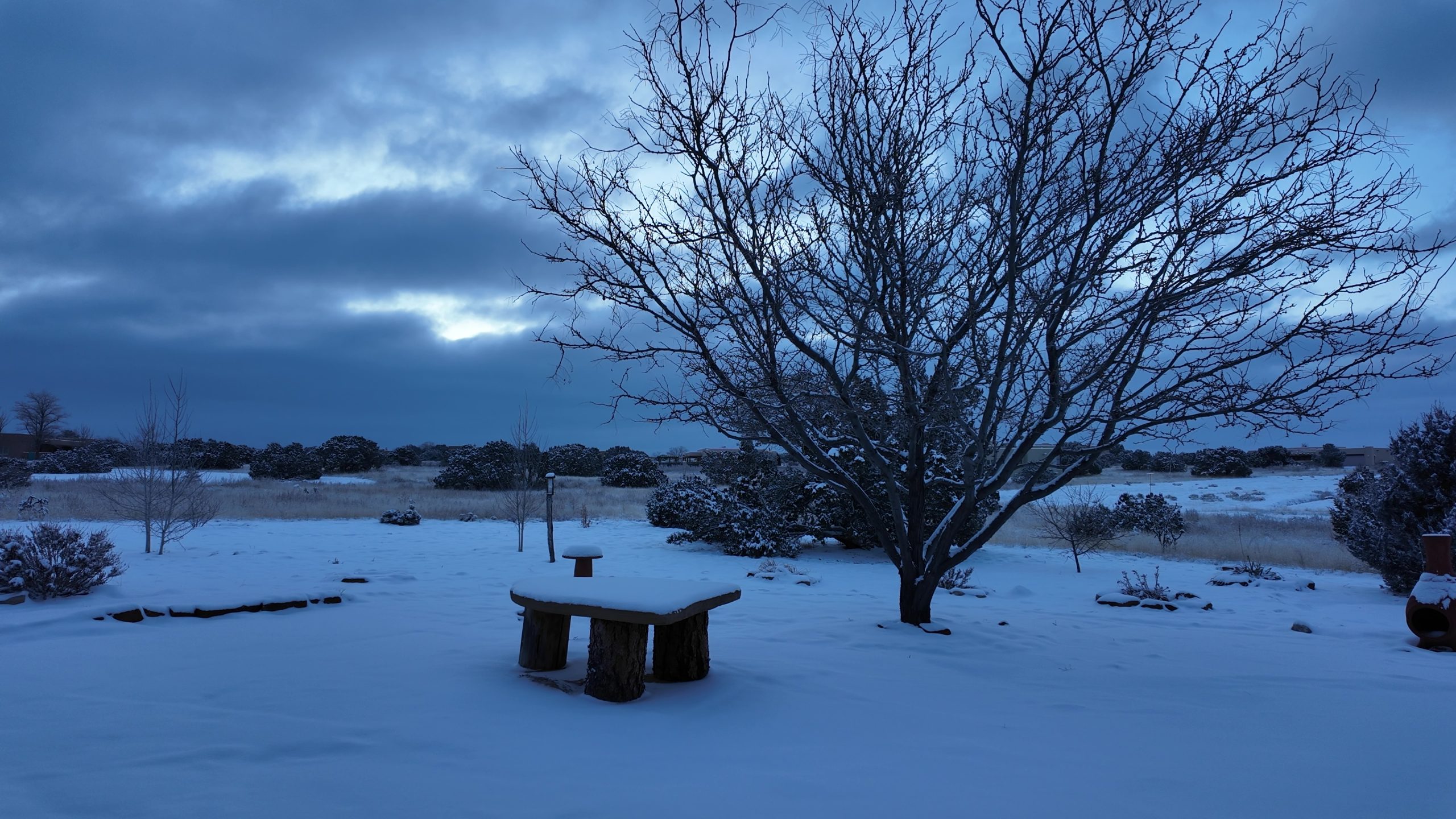
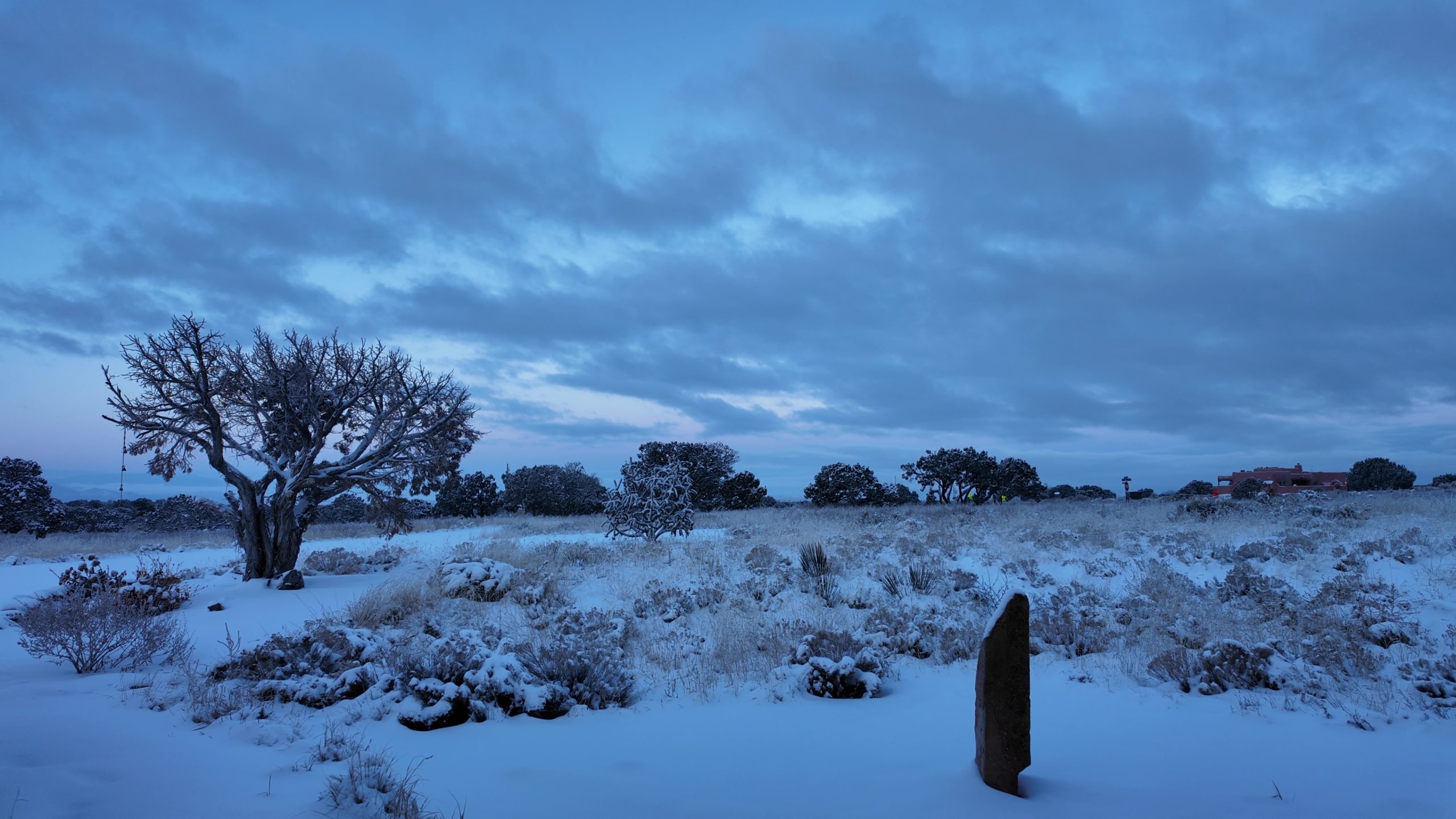
The accumulation is only about four inches, less than I might have hoped for, but typical for Santa Fe. The ground here stays warm enough that even at eleven degrees, it melts snow almost as fast as it falls, especially early in the season. But four inches is enough. Enough to coat every juniper branch, every piñon bough, every sage bush and chamisa stalk. The fresh snow transforms the high desert landscape into a study in contrasts—the dark, twisted forms of ancient junipers emerging from blankets of white, the ruddy bark of piñons highlighted against their snow-laden branches.
I continue along the north side of the house, moving slowly, giving the camera time to capture the scene. In the distance, I hear rather than see a car passing on the highway, its sound muffled by the snow covering the road, its passage marked only by the faint whisper of tires on winter pavement. It passes like a ghost, barely disturbing the morning's peace.
The light continues to improve, that flat, even illumination that comes with overcast skies proving ideal for videography. No harsh shadows, no blown-out highlights—just clean, documentary light that reveals every detail of the snow-covered landscape. The Pocket 3's gimbal keeps the footage smooth despite my careful steps through the snow, the image flowing steadily across juniper and piñon, fence line and garden, the various elements of our high desert sanctuary.
Rounding the south side of the house, I pause and zoom in toward the southwest. The Ortiz Mountains, normally a clear presence on the horizon about five miles distant, are barely visible this morning, ghostly suggestions in the middle distance, their forms softened by atmosphere and cloud. They're old mountains, the Ortiz, worn down by time and weather, rich in the turquoise and gold that drew people to this land long before Santa Fe became a city. On clear days, they provide a counterpoint to the Sangre de Cristos—where the Sangres are dramatic and young, sharp-peaked and commanding, the Ortiz are gentle and ancient, rounded and patient.
I swing the camera back north and east, where the Sangre de Cristo Mountains dominate the view. Even in this dim light, even partially obscured by cloud, they command attention. The fresh snow transforms the high desert landscape around Casa Santa Fe, but it's the mountains that define it, that give context and scale to everything else. Their name—Blood of Christ—comes from the way they catch the setting sun, turning deep crimson in the evening light. This morning, they're shades of white and gray, their peaks lost in cloud, their massive presence more felt than fully seen.
The cold is beginning to find its way through my sweatshirt now, a reminder that eleven degrees is still eleven degrees, wind or no wind. I complete my circuit of the house, taking my time, making sure the camera captures the full story of this winter morning. The video will be a time capsule, a record not just of what the landscape looked like after this particular snowfall, but of what it felt like to be here, to experience it firsthand.
Back inside, the warmth of the house feels like an embrace. I slide the patio door closed behind me and head straight for the coffeemaker. One more cup, earned now by my brief venture into the cold. While it brews, I connect the Pocket 3 to my laptop and begin reviewing the footage.
The quality is remarkable. The one-inch sensor has handled the low light beautifully, capturing detail in both the snow and the shadows, maintaining clean footage without excessive noise or grain. The stabilization has done its job too—the footage flows smoothly, the slight tremor in my hands invisible in the final result. And the audio—yes, the audio captured the crunch of footsteps in fresh snow perfectly, that simple sound that conveys winter authenticity better than any musical soundtrack could.
I scrub through the footage, pulling frame grabs for still photos. This is one of the beautiful things about modern video cameras—at 4K resolution, individual frames can serve as excellent photographs. A shot of snow-laden juniper branches against the gray morning sky. A wide view of the house with the Sangre de Cristos beyond. A detail of fresh snow clinging to a piñon's needles. These frame captures are better quality than what I could have achieved with expensive dedicated photo cameras just a few short years ago. Technology marches on, and sometimes it marches in favorable directions.
The coffee is ready. I pour another cup and return to the dining room table, to my spot by the window, but now the light has fully arrived. The landscape that was barely visible an hour ago now reveals itself completely. The clouds have broken up further, allowing patches of blue sky to show through. Where direct light hits the snow-covered junipers and piñons, they sparkle, each snow crystal catching and reflecting the light like millions of tiny diamonds.
This is what we miss during our winters at Lake Mohave—not just the snow itself, but the way fresh snow transforms the high desert landscape, the way it reveals the underlying structure and beauty of the plants and landforms that we take for granted in other seasons. The junipers that blend into the background in summer and fall become sculptural elements, their gnarled branches and irregular forms highlighted by their white covering. The piñons, normally subtle in their presence, stand out boldly, their dark green needles contrasting sharply with the accumulated snow.
And the moisture—the welcome moisture that this snow represents. Every flake that falls here matters. Every inch of accumulation translates to soil moisture for spring, to water for the root systems of these drought-adapted plants, to relief from the constant threat of wildfire that hangs over this landscape. The high desert is defined by its relationship with water, or more accurately, by its relationship with the absence of water. When precipitation comes, whether as summer monsoon rain or winter snow, it's cause for celebration, for gratitude, for acknowledgment that the cycles continue, that the land will endure.
I think about the nearly ten years that have passed since we last spent a full winter in snow country. Ten years of warm Arizona winters, of fishing for smallmouth bass in the crystal-clear waters of Lake Mohave, of exploring it’s many beautiful coves in the Key West center console, of desert sunsets and mild temperatures. Those winters have their own beauty, their own rewards. But they're not this. They don't offer this particular magic, this transformation, this reminder of the seasonal cycles that governed so much of my earlier life.
Growing up on the beef and dairy ranches in the Kansas Flint Hills, winter meant work—feeding livestock, breaking ice on water tanks, managing the challenges that cold weather brings to agricultural operations. During those seventeen years at Casa Oso, winter meant even more work—the constant battle with snow accumulation, the need to keep the driveway clear, the careful monitoring of propane levels and generator function in case of power outages. Here at Casa Santa Fe, winter is gentler, more forgiving, more about appreciation than management.
But appreciation requires presence, and presence requires time. We may only have a few more winters before we settle permanently back at Casa Santa Fe. That's what makes this morning feel particularly precious, particularly worthy of documentation. These opportunities to witness how fresh snow transforms the high desert landscape around Casa Santa Fe may be numbered, may be limited to these transitional years when we're mobile enough, healthy enough, flexible enough to split our time between two homes, two climates, two different expressions of the American Southwest that we love.
The video sits on my laptop now, several minutes of footage capturing this particular morning, this particular snowfall, this particular expression of winter at the foot of the Sangre de Cristos. It will be edited, titled, uploaded to the New Mexico Outdoor Sports Guide YouTube channel, where it will join hundreds of other videos documenting the wilderness and wildlife of Arizona, Utah, Colorado, and New Mexico. But before it becomes content, before it becomes part of the digital archive, it exists as memory, as experience, as a gift that this morning has given me.
Outside the window, more blue sky appears as the clouds continue to break up. The sun will come out fully soon, and when it does, the temperature will rise, the snow will begin to melt, and this particular transformation will begin its retreat. By tomorrow, much of this snow will be gone, absorbed into the earth or evaporated into the dry air. But the video will remain, and the memory will remain, and the gratitude for being here, in this place, at this moment, will remain.
I raise my coffee cup in a silent toast to winter, to snow, to the high desert landscape that surrounds Casa Santa Fe, to the Sangre de Cristo Mountains standing guard over it all, to the junipers and piñons that make this ecosystem unique, to the welcome moisture that sustains it, and to the privilege of being here to witness how fresh snow transforms the high desert landscape into something that never fails to inspire wonder, no matter how many winters you've seen, no matter how many miles you've traveled, no matter how much time has passed since you first fell in love with this extraordinary place.
Outside, the world sparkles in the emerging sunlight, and I'm content.
About the Author spent his early years working his family's cattle ranch in Kansas before pursuing a career in wildlife photography. Now retired and living in Santa Fe, New Mexico but wintering at Lake Mohave, Arizona he dedicates his time to documenting the wilderness and wildlife of the American Southwest, with a particular focus on the Mountains and Deserts of Arizona, Utah, Colorado and New Mexico. His work has been featured in New Mexico Outdoor Sports Guide blog and hundreds of NMOSG YouTube video publications, the Texas
SportsGuide and Black Bass magazines.



0 Comments