
Chasing the Blue at Nambe Lake
A summer day hike from the Santa Fe Ski Valley into one of the Sangre de Cristo's most quietly spectacular alpine basins
There are mornings in Santa Fe when the sky comes up such a hard, clean blue that it almost hurts to look at it — a blue so saturated and unapologetic that it makes you want to chase it right up into the mountains. That's exactly the kind of morning Paulette and I had when we laced up our trail shoes and aimed the Subaru Outback up Hyde Park Road toward the Santa Fe Ski Valley, bound for Nambe Lake.
It was early summer — one of those warm, golden-lit days that make you forget how quickly the high country can turn on you. The aspens along the upper stretch of Highway 475 were still wearing their fresh lime-green, and the air coming through the windows smelled like pine resin and cold water. By the time we pulled into the ski valley parking lot and shouldered our day packs, the anticipation of a full day in the mountains was sitting in our chests like a good strong cup of coffee.
Nambe Lake sits tucked into a high alpine cirque in the Pecos Wilderness, part of the Santa Fe National Forest and the broader Sangre de Cristo Mountains — a range whose very name, "Blood of Christ," hints at the way afternoon alpenglow turns the quartzite ridges a deep, burning red. The lake itself sits at roughly 11,000 feet, cradled in one of the oldest geological formations in New Mexico. The rock you'll be walking among is Precambrian granite and metamorphic gneiss — ancient stuff, more than a billion years old — shaped first by unimaginable tectonic forces and then slowly carved into its present bowl shape by glaciers that retreated at the close of the last ice age. What you see at Nambe Lake is, in the truest sense, the skeleton of the continent.
Getting started: the ski valley to the trail
The hike to Nambe Lake begins right at the Santa Fe Ski Valley, which sits at about 10,350 feet — a starting elevation that will remind your lungs pretty quickly that this is no stroll in the bosque. Ski Santa Fe, one of the southernmost ski areas in the Rocky Mountain chain, sprawls across the upper slopes of the Tesuque Peak massif. In winter it's all groomed runs and ski lifts; in summer, once the lifts go quiet and the snow recedes, it gives way to some of the best high-country hiking in New Mexico.
From the parking lot, the trail begins with a modest but pleasant stretch alongside a small stream — cool, clear snowmelt tumbling over stones, doing its best to lure you into just standing there and listening to it. For the first fifty yards or so it runs right at your elbow, then the trail angles uphill and you leave the stream behind as you begin the initial climb. It's roughly a half mile of ascending before the grade eases, and it warms you up nicely, working the calves and reminding you why you bothered with the hiking poles.
The forest up here is what ecologists call a subalpine conifer zone — the last stand of trees before the land gives up on them entirely and becomes tundra. You're moving through a cathedral of conifers: Engelmann spruce, subalpine fir, and the occasional bristlecone pine, some of them genuinely ancient, their gnarled silhouettes a quiet record of centuries of wind, ice, and summer lightning. Mixed in among the conifers, particularly in the moister draws, the quaking aspens shake their round leaves in even the faintest breeze. In early summer they're brilliant green; by late September they'll be burning gold and amber, putting on one of the Southwest's great natural spectacles. Walk quietly and you might flush a Clark's nutcracker from the upper branches, its gray and black feathers flashing as it scolds you for the interruption.
Through the gate and along the Winsor Trail
Not far up the trail you'll pass through a gate — a simple but deliberate threshold marking your transition from the ski area into the Pecos Wilderness. Once through it, the trail levels out considerably, and you find yourself on the Winsor Trail, one of the great high-country arteries of the Sangre de Cristos. Named for a nineteenth-century ranching family, the Winsor Trail threads through one of the most geologically complex and scenically rewarding stretches of the entire range.
Walking this section, it's worth pausing now and then to look at what's underfoot. The trail surface alternates between decomposed granite gravel — pink and glittering with feldspar and quartz — and outcroppings of dark, banded metamorphic rock that has been folded and refolded over geological time into shapes that resemble kneaded bread dough. This is the Precambrian basement of the continent, and you're walking directly on top of it. There's a particular pleasure in that, especially for anyone who's spent time reading the landscape.
The Winsor Trail section is almost level, a welcome breather after the initial climb, and it offers the kind of hiking that lets you lift your eyes from your feet and actually look around. The forest opens up in places, and you get glimpses south and west toward the high ridgeline, patches of sky appearing between the spires of spruce. Wildflowers crowd the trail edges in early summer — scarlet gilia, blue columbine (New Mexico's state flower), and clusters of white yarrow. Hummingbirds, attracted by the gilia's red trumpets, appear suddenly and disappear just as fast, little jets of iridescent green hovering for a half-second before rocketing upward.
Rio Nambe: the sound before the sight
You hear Rio Nambe before you see it. That's one of the small pleasures of this trail — the moment when the wind shifts just right and the rush of water comes to you through the trees, growing louder with each step until you round a bend and there it is: Rio Nambe, running cold and fast over rounded stones, fed by the snowpack above and in no particular hurry to slow down. The river is modest in scale but emphatic in personality, the kind of mountain stream that insists on being heard.
Rio Nambe drains the high alpine basin above and eventually works its way down-watershed toward the Nambe Pueblo and the Rio Grande, a journey of many miles and many elevation changes from this high, cold source. Up here it runs through a narrow corridor of willows and alder, their roots gripping the streambank like arthritic fingers. The crossing, depending on the snowmelt season, can range from a simple rock-hop to a deliberate wade — in early summer, after a good snowpack year, it can be surprisingly vigorous. Waterproof hiking shoes are a genuine asset here, not a luxury.
The final push: steep, wild, and worth every step
Here is where the hike changes character entirely. The spur trail from the Winsor Trail up to Nambe Lake is only about a mile in length — barely a few minutes' walk on flat ground. But this is emphatically not flat ground. The trail climbs steeply through a section of forest that sees considerably less foot traffic than the Winsor Trail below, and it shows. The path is less worn, in places only faintly defined, threading through downed logs and root tangles that require your full attention. This is not a trail for the distracted hiker.
Accompanying you on the climb are two sounds: the persistent rush of water from the streams feeding the lake above, audible even through the dense timber, and the sharp, staccato hammering of a woodpecker working somewhere in the dead snags. Up in this elevation band, Williamson's sapsuckers and three-toed woodpeckers are both possibilities, the latter in particular favoring the beetle-killed spruce that are increasingly common throughout the Southwest's high forests. Their drumming echoes off the rocky walls above and gives the final approach to the lake a slightly theatrical quality, as though the mountain is announcing your arrival.
Paulette and I pulled our sweatshirts from our packs somewhere along this stretch, and the windbreakers came out not long after. Even on a warm sunny day in the valley below, the upper portion of this trail operates on its own thermal schedule. Snow patches linger on the north-facing aspects well into June, sometimes covering the trail entirely, and the air filtering down from the rocky ridgeline above carries a genuine chill. Layer up before you need to — it's easier than stopping to dig through your pack when you're already cold and breathing hard.
Nambe Lake: arrival
And then, with very little ceremony, the trees part and you are there.
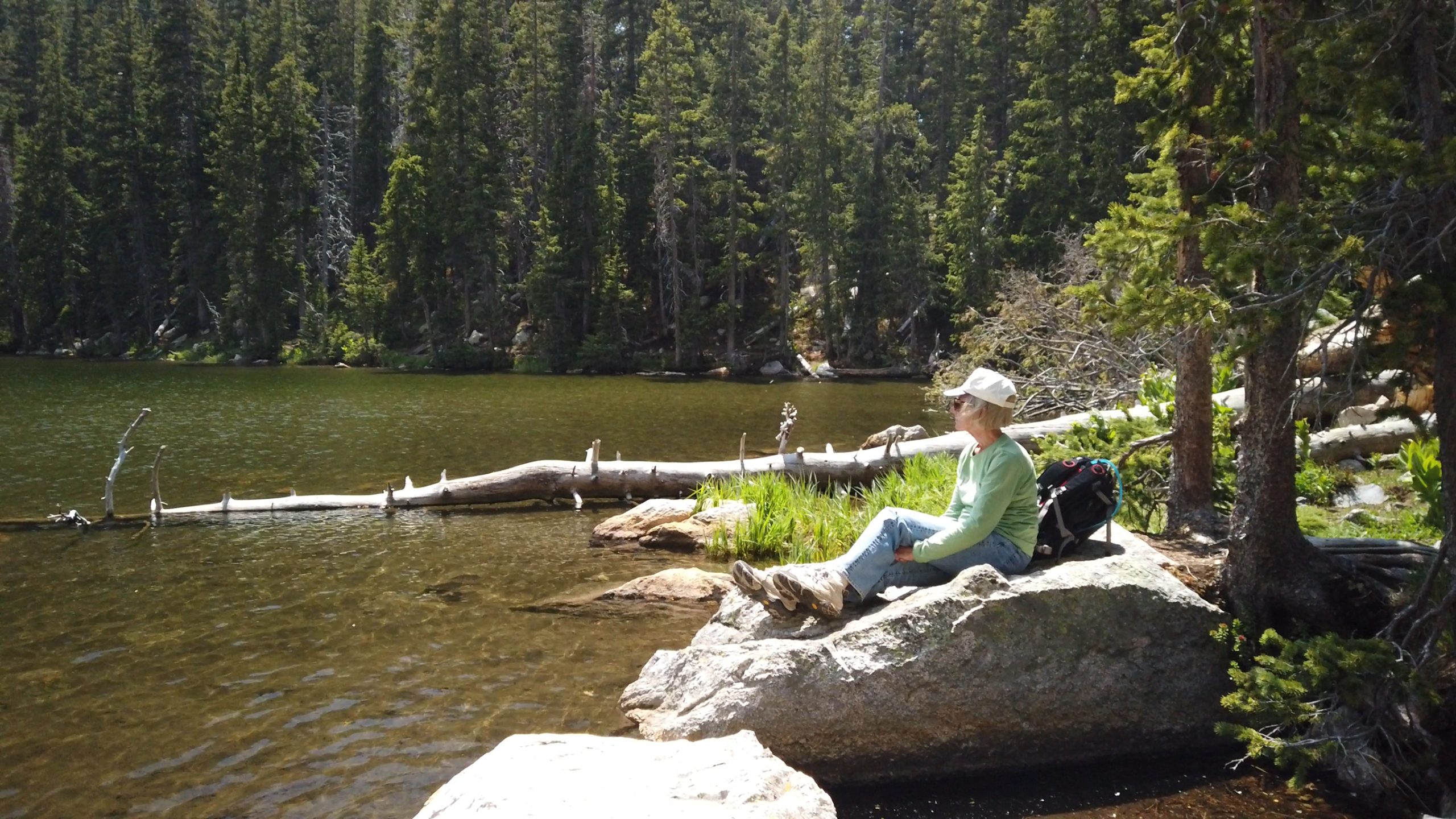
Nambe Lake appears with the abruptness characteristic of alpine lakes tucked into glacial cirques — one moment you're in forest, the next you're standing at the edge of something that stops you in your tracks. The lake itself is compact and deeply blue, set in a natural bowl of polished bedrock and talus. Behind it, rising without apology, is a rocky, nearly treeless ridge of Precambrian quartzite and granite, the kind of hard, austere skyline that reminds you how old and indifferent mountains are. There's no softness up there, no vegetation to buffer the rock's sharp angles. It's all angles and shadows and sky.
The breeze coming off the lake and through the ragged fringe of spruce and fir at the water's edge carries a chill that's bracing rather than unpleasant — the particular cold of high, shaded water that hasn't fully shaken off winter. It smells of pine and mineral and something harder to name, that ozone-adjacent quality that high mountain air sometimes carries after the melt begins.
We hiked around the lake's perimeter, picking our way over the talus and through the rocky inlets where small streams spilled in from the snowfields above. The streams were clear enough to read newspaper through, running over granite pebbles in a hundred shades of gray, white, and pink. It's a good place to simply stand and listen to water
0 Comments