
Here I am again, hunkered down indoors on a raw, bone-chilling early March 2026 morning in Santa Fe, New Mexico, the kind of day where the cold seeps right through the adobe walls and makes you grateful for a wool blanket and a hot mug of coffee. Outside, the high desert sky is the color of old pewter, and there's not much calling me beyond the window glass. So I've been doing what a man of eighty-plus tends to do on such days — scrolling through old video files, reliving moments that the calendar keeps putting further and further behind us.
And that's when I found it.
Tucked away in a folder labeled simply "May 2019," a video file glowed on the screen. I double-clicked it, and just like that, the gray March morning dissolved. Suddenly I was watching warm golden sunlight dancing off the stones along the Santa Fe River, Paulette laughing at something just off-camera, a pair of cottontails disappearing into the chamisa — and I remembered every blessed minute of it like it was last Sunday.
It was Mother's Day, 2019, and Santa Fe, New Mexico was putting on quite a show.
A Ranch Kid's Idea of a Perfect Holiday
Now, I didn't grow up celebrating Mother's Day with restaurant reservations and flower bouquets, though I surely appreciate those things. I grew up on the Flint Hills of Kansas, where the tallgrass prairie rolled on forever and a holiday meant something simple and real — maybe a long ride out to check the cattle, a big Sunday dinner with family of seven brothers and one sister around a table that wasn't quite big enough, and afterward sitting out on the porch watching the hawks circle the sky. Celebration meant being present, not performing it.
So when Mother's Day 2019 rolled around and Paulette — my bride of more than forty years, my partner through every adventure this old life has thrown our way — was asked what she'd like to do, she didn't hesitate long. She wanted to be outside. She wanted the river.
That's my girl.
We swung by one of our favorite barbecue spots on the way and picked up a couple of take-out lunches. There's something almost ceremonial about carrying a bag of good BBQ into the open air. The smell alone is enough to make the whole enterprise feel festive. We wound our way down into the heart of Santa Fe, New Mexico, past the old neighborhoods with their thick-walled compounds and flowering fruit trees, and found our way to a quiet concrete picnic table right alongside the Santa Fe River.
And let me tell you — lunch always tastes better outside. Always. Doesn't matter if it's a gourmet spread or a paper plate of smoked brisket and coleslaw. There's something about open sky overhead and moving water nearby that sharpens every flavor, relaxes every muscle, and makes a man feel like he's exactly where he's supposed to be.
The Santa Fe River — Small Stream, Big Soul
The Santa Fe River doesn't ask for much attention. It's not the Colorado, roaring and muscular through red canyon walls. It's not even the Rio Grande, that broad brown elder winding down through the heart of New Mexico. The Santa Fe River is modest, a gentle murmuring presence threading through the city like a silver thread through old turquoise.
But don't underestimate her.
She's been here a good deal longer than any of us, running down from the Sangre de Cristo Mountains and carving the valley that gave this old city — one of the oldest capitals in the United States — its reason for being in the first place. The cottonwoods along her banks are grand old trees, thick-trunked and generous with their shade. In spring, their new leaves are that impossibly tender yellow-green that makes you feel young just looking at it. Willows trail their fingers in the current. Robins and sparrows argue in the branches overhead.
We found our table in a quiet stretch of the riverwalk, away from the weekend foot traffic, close enough to the water to hear it talking over the smooth stones. We spread out our BBQ lunches and ate slowly, the way I've learned to eat most things as I've gotten older — paying attention, not rushing, tasting every bite.
After years on a ranch, years in the cockpit logging more than 2,600 hours of flight time across this country, years building and running businesses, years chasing bass tournaments across Texas and Louisiana — I've finally learned the art of slowing down. The high country taught me that. Seventeen years at Casa Oso, our log home perched at 9,500 feet above Angel Fire, overlooking the Moreno Valley with Wheeler Peak standing tall to the west and Eagle Nest Lake shimmering below — that country teaches patience. It teaches you to sit still and look hard at what's right in front of you.
What was in front of me that Mother's Day was my wife of four decades, a plate of fine barbecue, and a singing river. That's a rich man's morning by any measure.
The Walk Downtown — Santa Fe, New Mexico Unwrapped
After lunch, we laced up our walking shoes and set off downstream along the riverwalk, the late-spring sun warm on our shoulders. The idea was simple: follow the river a mile or so into the heart of downtown, make a loop around the Plaza, and wander back the way we came.
Easy. Leisurely. Perfect.
The Santa Fe River trail passes through some of the most quietly beautiful urban scenery I've encountered anywhere in the American Southwest. The Sangre de Cristo Mountains kept watch over us to the east, their slopes still carrying patches of snow in the high country, rose-colored in the afternoon light the way their name — Blood of Christ — promises they will be at dusk. I've looked at those mountains from my window here in Santa Fe almost every day since Paulette and I settled at Casa Santa Fe in 2017, and they still stop me cold every time.
As the riverwalk delivered us deeper into town, the city's layered history began to announce itself in stone and steeple and adobe.
Loretto Chapel — A Miracle in Wood
We passed near the Loretto Chapel, that elegant little Gothic gem standing quietly just off the river walk corridor, and I'm always moved by it. Built in the 1870s by the Sisters of Loretto, it stands barely larger than a country church back in Kansas, but it carries itself with the confidence of a cathedral. The stone is soft and warm, the stained glass old and glowing.
What gets people talking, of course, is the staircase inside — the famous spiral staircase built without a central support, constructed by an unknown craftsman who appeared from nowhere, completed his work, and vanished without collecting a cent. Local legend calls it a miracle. Engineers call it a mystery. I call it a reminder that Santa Fe, New Mexico has always attracted extraordinary souls who leave extraordinary things behind.
The Cathedral Basilica of St. Francis of Assisi
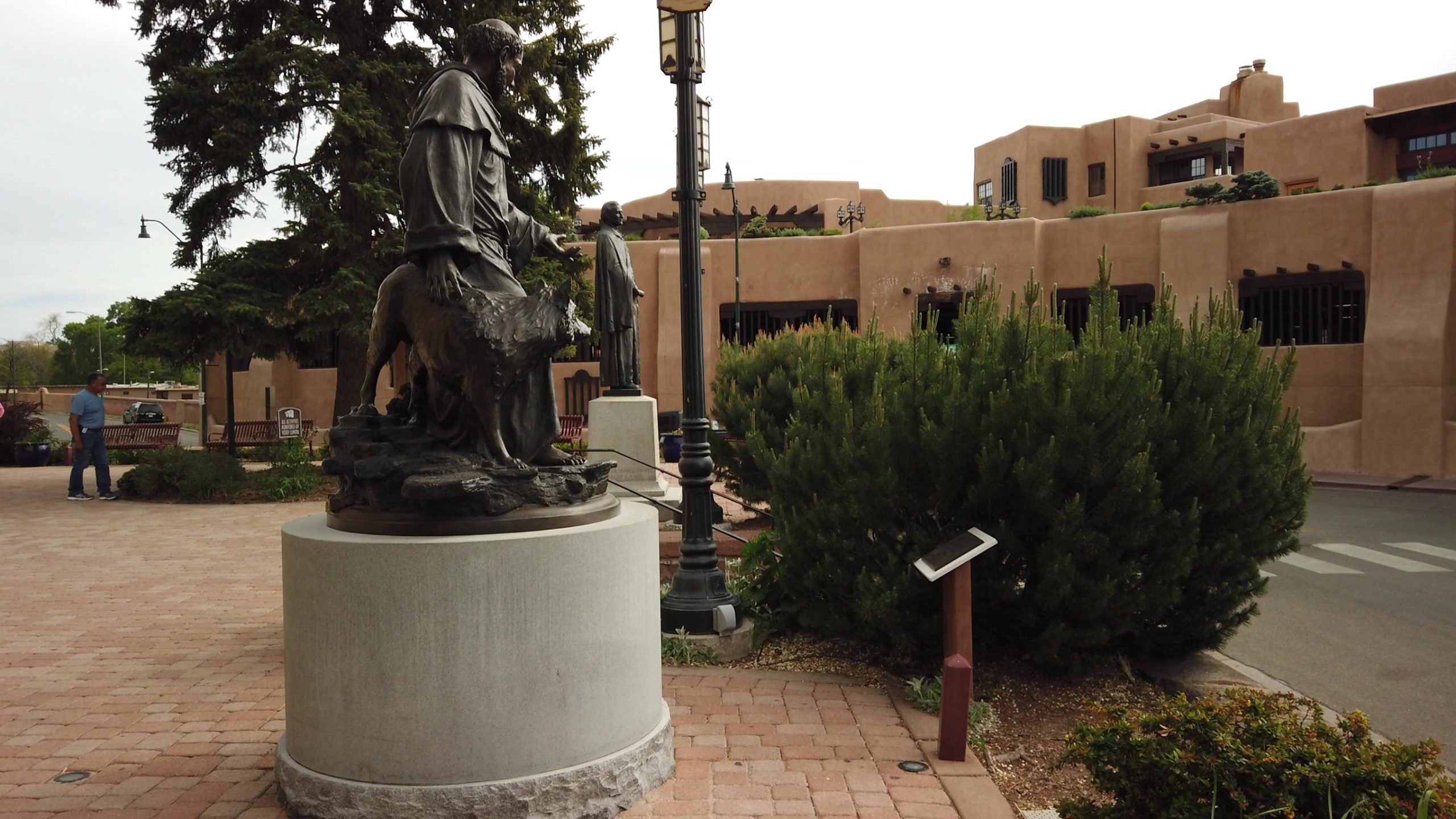
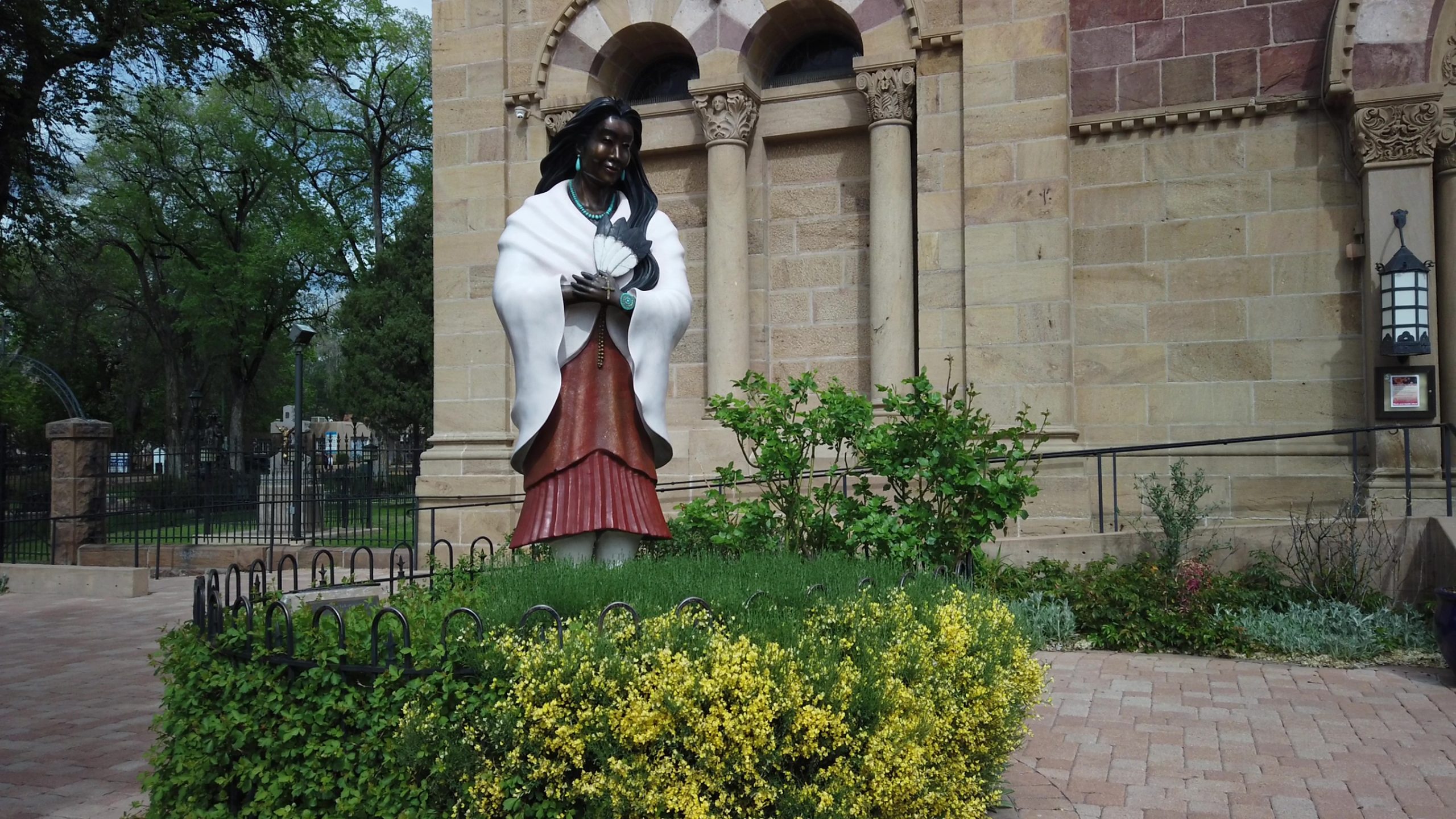
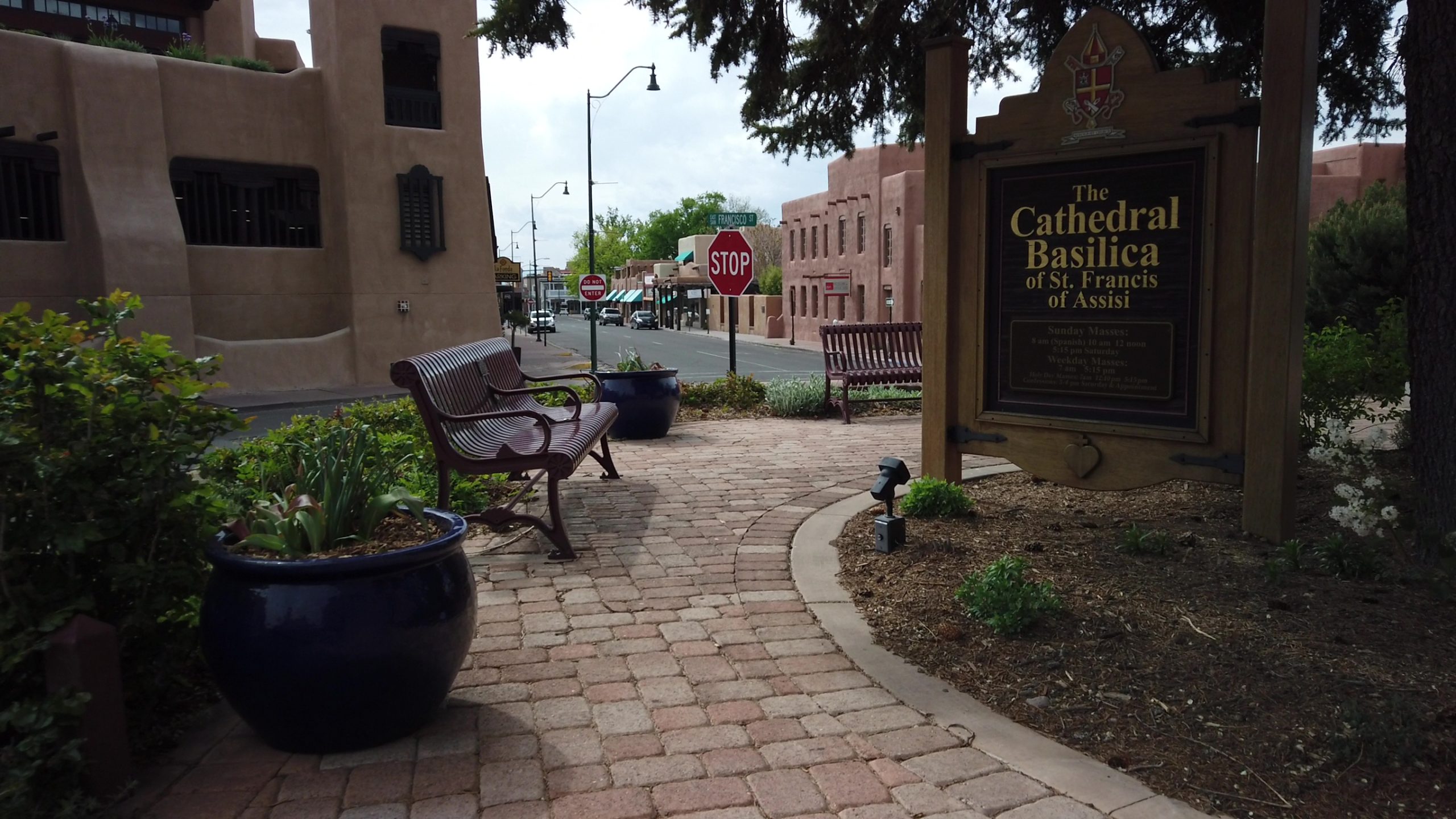
A short walk from the river and you're standing in the shadow of the Cathedral Basilica of St. Francis of Assisi, and if that doesn't stop you in your tracks, check your pulse. Archbishop Jean-Baptiste Lamy broke ground on this Romanesque Revival masterpiece in 1869, building it around the older adobe church that had stood on the site since the 1600s. The twin towers rise against that impossibly blue New Mexico sky, the golden stone glowing in the sunlight.
I've spent a fair amount of time in wilderness country — deep ponderosa forest, slickrock desert, alpine meadows above the treeline — and I've always found the sacred in those outdoor places. But standing before the great arched entrance of St. Francis Basilica in Santa Fe, New Mexico, you feel a different kind of silence. A gathered silence, centuries deep, full of human longing and human beauty.
IAIA Museum of Contemporary Native Arts
Not far from the Cathedral is the IAIA Museum of Contemporary Native Arts — MoCNA — housed in the historic Federal Building on the corner of Cathedral Place and Federal Place, and I think it's one of Santa Fe's best-kept secrets among visitors who don't know to look for it.
The Institute of American Indian Arts has been nurturing Native American and Alaska Native artists since 1962, and MoCNA is where that creativity comes to be seen and celebrated. The work inside is alive, challenging, deeply rooted and fiercely contemporary all at once. If you think you know what Native American art looks like, MoCNA will respectfully and powerfully show you how much broader and wilder the real territory is. For a man who has spent years photographing the landscapes, wildlife, and cultures of the American Southwest, it speaks to something deep.
Palace of the Governors — Where New Mexico's History Lives
No stroll around Santa Fe, New Mexico's historic Plaza is complete without pausing at the Palace of the Governors, the long, portal-fronted adobe building that faces the north side of the Plaza. Completed around 1610, it's the oldest continuously occupied public building in the United States, and it wears its age with remarkable dignity.
Along the portal, Native artisans spread their jewelry, pottery, and weavings on blankets and small tables, as they have done for generations. Turquoise and silver catch the sunlight. Pottery the color of desert earth sits in quiet rows. I always slow down when I walk past here, not necessarily to buy anything, though we usually do, but to look at the faces — the craft, the patience, the living connection to something very old and very real. Out where I grew up in the Kansas Flint Hills, we had our own relationship with the land, our own way of reading weather and terrain. I feel a kinship here that's hard to name but impossible to ignore.
Inside the Palace is the New Mexico History Museum, and if you have a few hours to spend understanding the extraordinary, complicated, layered story of this state — the Spanish colonial era, the Mexican period, the American territorial days, the Santa Fe Trail, the pueblos that predate all of it by centuries — there's no better place to start.
The Plaza and La Fonda — The Beating Heart of Santa Fe
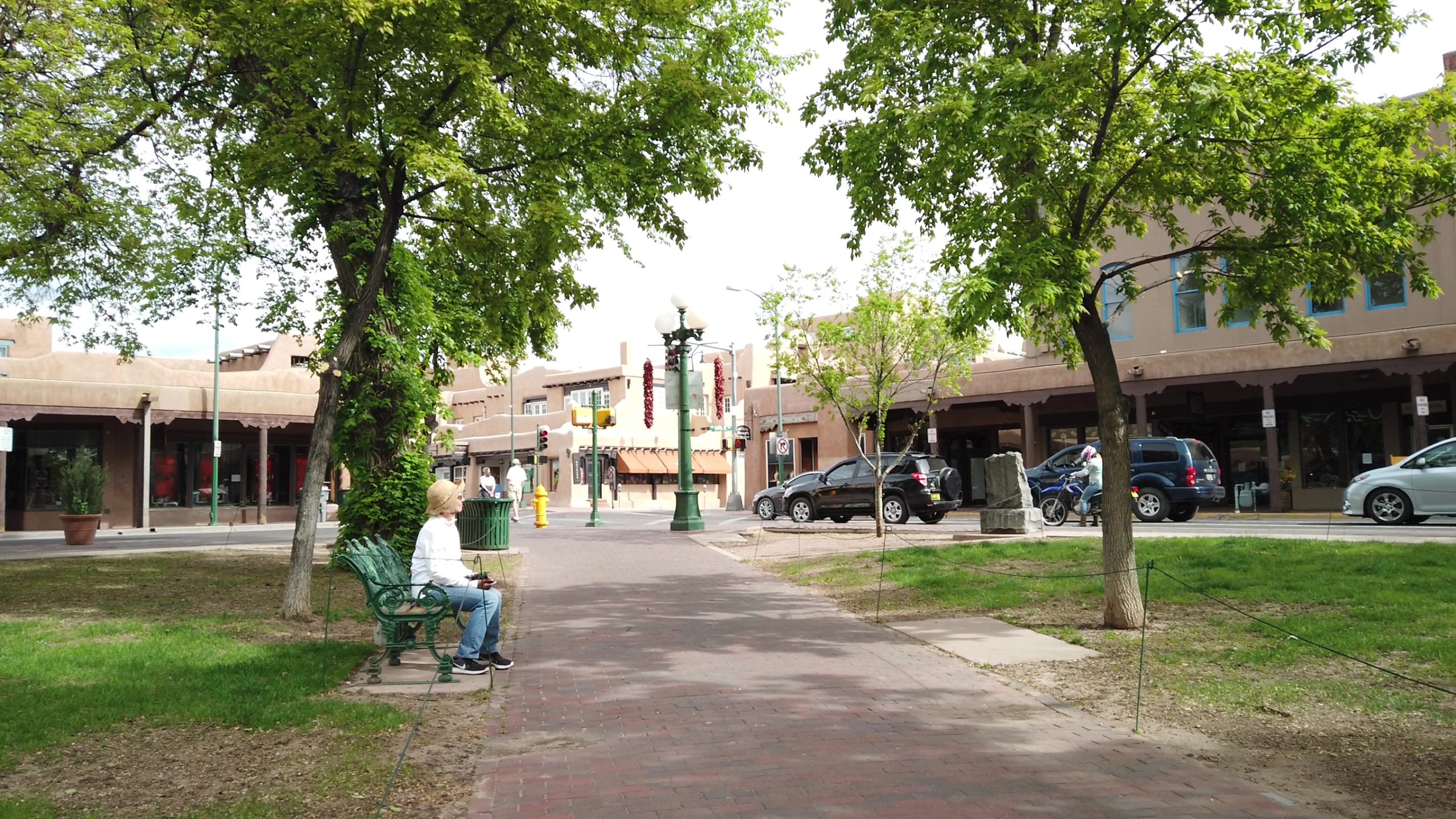
The Plaza itself was everything that Sunday. Paulette and I drifted along its brick paths, peering into shop windows — fancy gift shops selling everything from hand-tooled leather to turquoise the size of a thumbnail to paintings of blue-eyed coyotes gazing at full moons. We window-shopped with no intention of buying anything beyond maybe an ice cream cone, which is exactly the right way to window shop.
Eventually we found an empty park bench under one of the big elm trees and settled in to do what old hands at living know to be one of life's underrated pleasures: watching people go by.
Santa Fe, New Mexico on a beautiful Sunday is quite a people-watching venue. Young families with strollers, old couples holding hands, backpackers with dusty boots, a trio of Pueblo elders in traditional dress heading toward the Palace portal, a pair of tourists consulting a map on a phone, a dog with an enormous mustache trotting purposefully across the bricks. Thirty minutes passed like five.
Nearby, the great adobe mass of La Fonda on the Plaza anchored the southeast corner as it has for centuries — or at least the idea of an inn on that corner has, since there's been a fonda, a "wayside inn," on that spot since at least the 1600s. Today's La Fonda is a gorgeous Pueblo Revival landmark, its thick walls and portal-shaded entrance giving it the look of something grown rather than built. We've had dinner there on occasion, and I always feel like we're eating inside a piece of New Mexico history.
Retracing Our Steps Home Along the River
The walk back along the Santa Fe River was quieter, afternoon light now slanting low and warm. The cottonwoods threw long gold shadows across the path. A great blue heron — tall, still, prehistoric — stood in the shallows not twenty feet from the trail, watching the water with the infinite patience of something that has no need to hurry.
I stopped and watched him for a long time.
Paulette stood beside me, neither of us saying anything, the river talking softly between the stones. Behind us, the city hummed its gentle Sunday afternoon hum. Ahead, the path curved back toward the car. The Sangre de Cristo Mountains turned rose-gold in the late sun above the rooftops.
I thought about my mother, gone many years now, a ranch woman of remarkable strength and grace. I thought about Paulette, the mother of our family, standing beside me with the same quiet steadiness she's brought to every mile of the road we've traveled together. I thought about how lucky a man can get, if he pays attention.
Mother's Day, Done Right
All in all — a great way to spend Mother's Day.
Good barbecue. A singing river. Old stones full of history. A bench in the Plaza, watching the human parade go by. Mountains turning rose at dusk. A heron standing still in the current, teaching a lesson I'm still learning.
Santa Fe, New Mexico has a way of giving you exactly what you didn't know you needed. That Mother's Day in 2019, it gave us the whole beautiful package.
Now if you'll excuse me, it's still bitter cold out there in March 2026, and I've got a mug of coffee going cold and another folder of old videos waiting. Maybe I'll find the one from Eagle Nest Lake, or the morning we watched the bull elk at first light in the Moreno Valley meadow just below the house.
Those stories will keep for another day.
Pat photographs and films the wilderness and wildlife of the American Southwest for the New Mexico Outdoor Sports Guide blog and YouTube channel. He and his wife Paulette divide their time between Casa Santa Fe in Santa Fe, New Mexico, and Casa Codorniz at Lake Mohave, Arizona.
Tags: Santa Fe New Mexico, Santa Fe River, Mother's Day, Santa Fe Plaza, Loretto Chapel, Cathedral Basilica of St. Francis of Assisi, MoCNA Museum, Palace of the Governors, La Fonda Hotel, Sangre de Cristo Mountains, New Mexico travel, Santa Fe things to do, New Mexico Outdoor Sports Guide








0 Comments